

Raising Boys in a World That Hates Women: Why I Refuse to Stay Silent
There’s a harsh reality facing our kids these days, especially our sons.
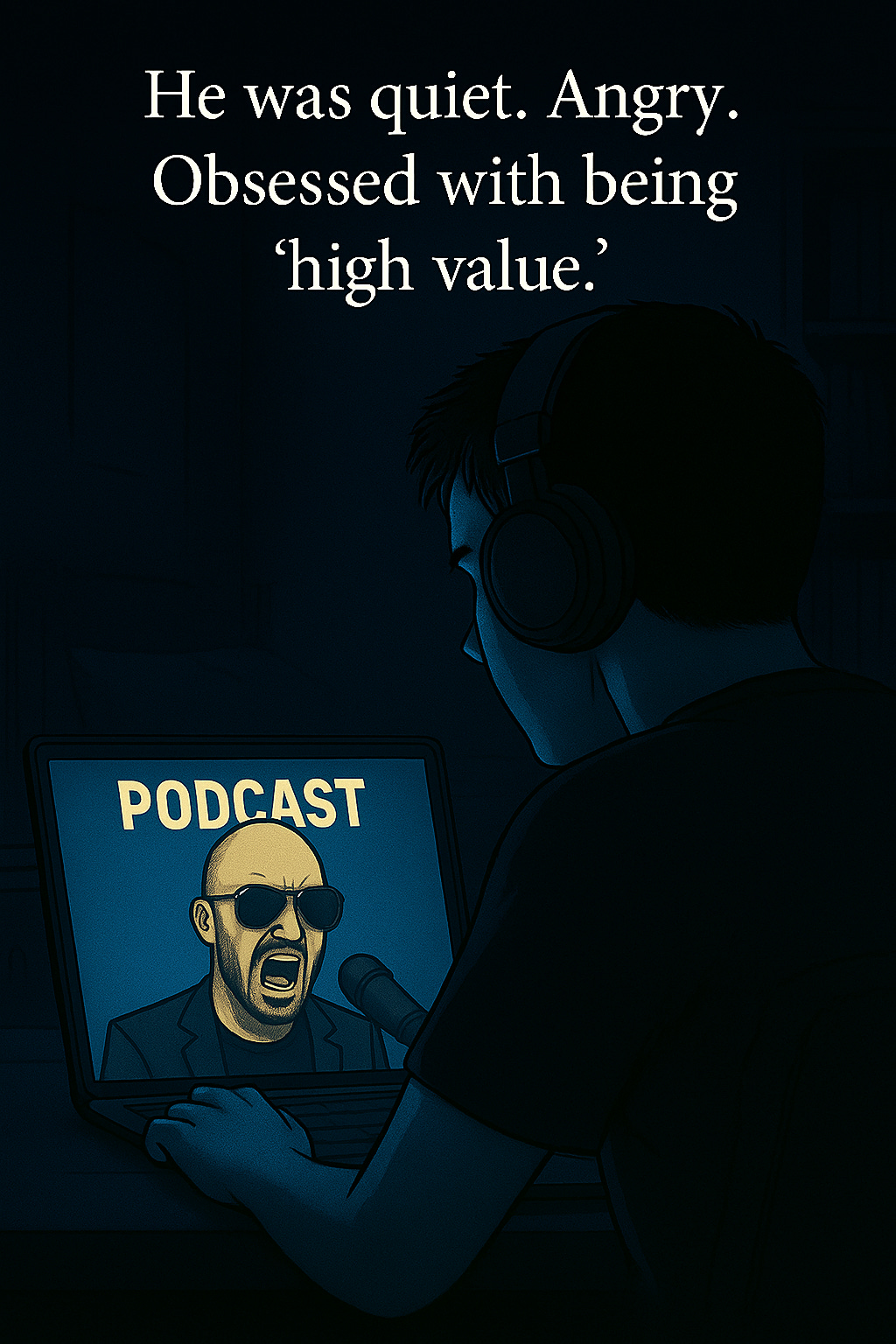
Like it or not, we’re raising our kids in a world that’s pressuring our boys into woman-hating, performance-raging assholes. And as dads, we’re failing them. Let’s face the facts. If our sons are learning about girls from Andrew Tate and the entire sphere of influence (called the manosphere), we’re losing. The staged videos with rented jets, cars, and champagne sicken me. I’m sick of the videos berating women. I’m sick of these assholes telling my kids that is what success looks like. Otherwise, they’re losers. Bullshit. Enough is enough. It doesn’t make them men. And it seriously threatens the women.
If you’re not familiar, “incel” stands for “involuntarily celibate,” but it’s come to mean a lot more than someone who just isn’t dating or getting laid. It’s a swath of our younger generation of boys that are getting outright rejected; by girls, by schools, by social groups, by employers. And there is always someone to blame for this rejection, women, immigrants, people of color, people who are different, the vulnerable. It’s a universe of online anger, shame, and resentment, blame and mostly young men who feel rejected by women and society. The stories are hard to read. The outcomes are even harder to think about, especially as a parent.
Identifying as an incel usually entails the following ideologies:
Anti-feminists: they blame feminism for societal decline and male disenfranchisement.
Race and genetic determinism: A common belief in pseudoscientific racial hierarchies, genetics determines social status, appearance, and sexual success. (Only the good-looking are successful).
Victimhood and conspiracy theories: Promotes narratives of oppression by “liberal elites,” feminism, or immigration, creating a sense of perpetual grievance.
Glorification of violence: Both communities often express fantasies of violence as revenge or restoration of perceived lost dominance.
Online radicalization pipelines: Shared spaces and algorithms frequently funnel users from alt-right content directly into incel ideologies and vice versa (often through YouTube, Reddit, Telegram).
WE NEED TO HAVE “THE TALK”.
Growing up, dads all knew when it was time to have “The Talk” with their sons. And it was usually awkward and embarrassing for both dad and son. In my case, going to a Catholic school, it was extremely awkward. At an evening meeting, all the eighth grader boys and their dads gathered in the school cafeteria, and Fr. Martello would introduce a local doctor.
The doctor would explain the mechanics.
“When in love, a man will stick his penis into a woman’s vagina. And nine months later, a baby is born,” the doctor would proudly exclaim.
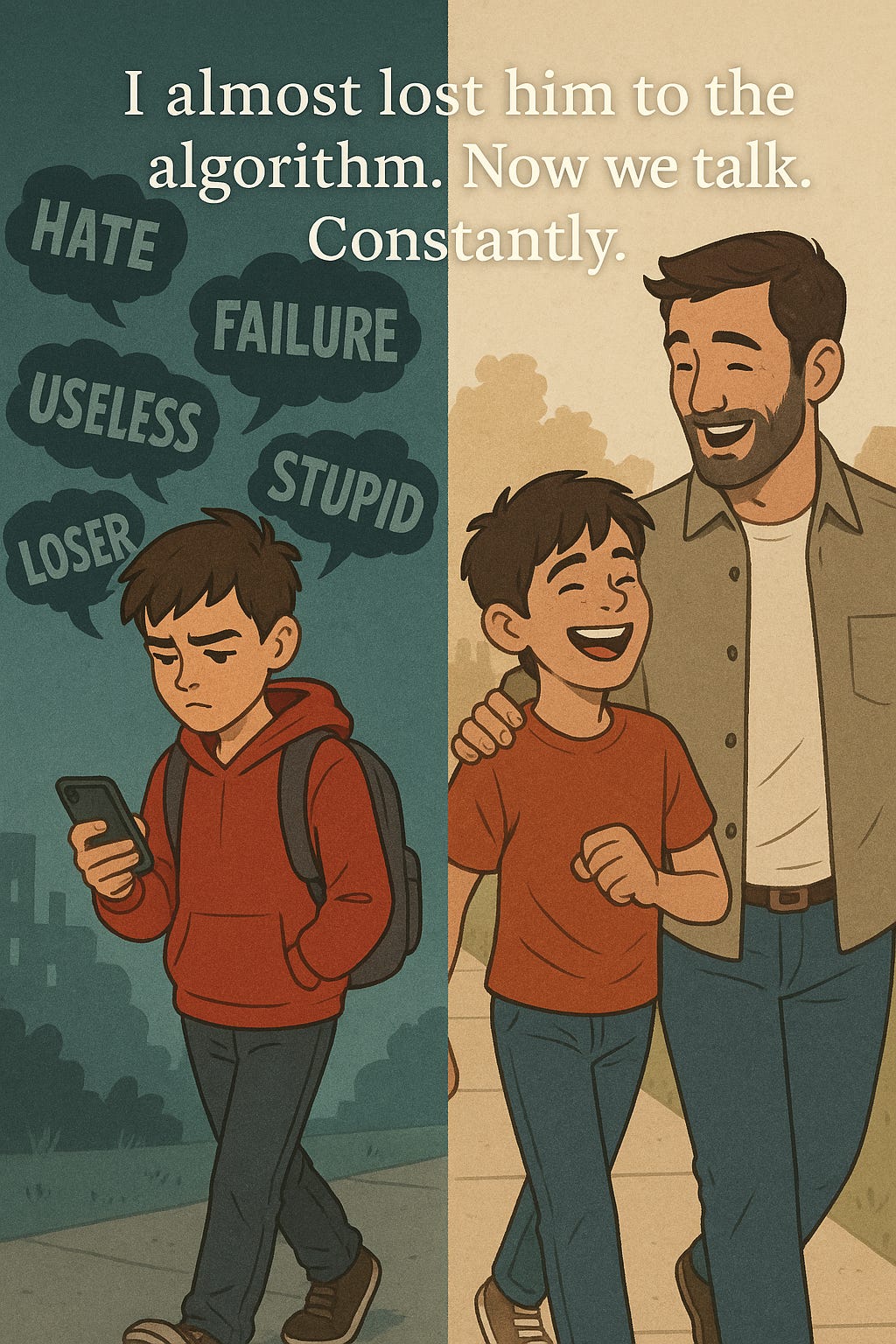
It was useless. The kids all snickered to cover their confusion, and the dads stood in the back talking about football. Today, we need to have constant conversations with our kids, both boys and girls. Because if we don’t have those tough, and sometimes embarrassing, conversations with our kids, someone on X, Snapchat, Discord, Kix, and in their online gaming chat rooms will. And that’s just fucking dangerous.
WHAT DO WE NEED TO TALK ABOUT?
First, we need to teach them to recognize the red flags. Buzzwords, grievance language, coded sexism. We spot it together so they know how to spot it alone.
1.) Kill the Algorithm
This is the line every parent is trying to walk right now. I don’t want to spy on them, but I want to know which corners of the internet they’re wandering into. We talk about what they see online. I want them to know they can bring it to me, no judgment.
The current hellscape of TikTok grifters, Discord rage pits, toxic YouTube channels and hate-spewing X posts scares the hell out of me. The internet is the modern-day Pinocchio Pleasure Island where curious boys searching for answers can freely explore any vice that they have questions about, smoking, drugs, drinking, vandalism.
Can I just block all the sites and ban all electronics from their room? I can try. But there are too many access points: home, school, phones, friends’ phones, friends’ homes. I need to teach them how to recognize it and make the choice to avoid it. Not just block it. Kids always think forbidden fruit tastes better. They need to make the choice.
Multiple studies have shown that YouTube’s recommendation engine can pull users toward increasingly misogynistic and extremist content, even starting from benign videos, and cross them gradually into incel or far-right ecosystems. One analysis found a 6.3% chance of a user being shown an incel-related video within five recommendation steps, even if they start with harmless content. Xiv.
Discord’s hidden influence: Discord’s structure, private servers, minimal moderation, has made it a fertile ground for extremist grooming. In one case, a white-nationalist group leaked thousands of messages revealing coordination inside Discord servers. Even adolescents have produced hateful messages in youth-focused chats: 6.4% of annotated Discord messages by under‑20s were hate speech WikipediaarXiv.
Gaming chat exploitation: Extremist actors often infiltrate voice/text chat in online games. They use trust built in-game to introduce hateful ideas slowly. The FBI and DHS have confirmed that gaming platform chats are used to recruit vulnerable youth Government Accountability OfficeMigration and Home Affairs.
2.) WHERE DOES HATE LIVE?
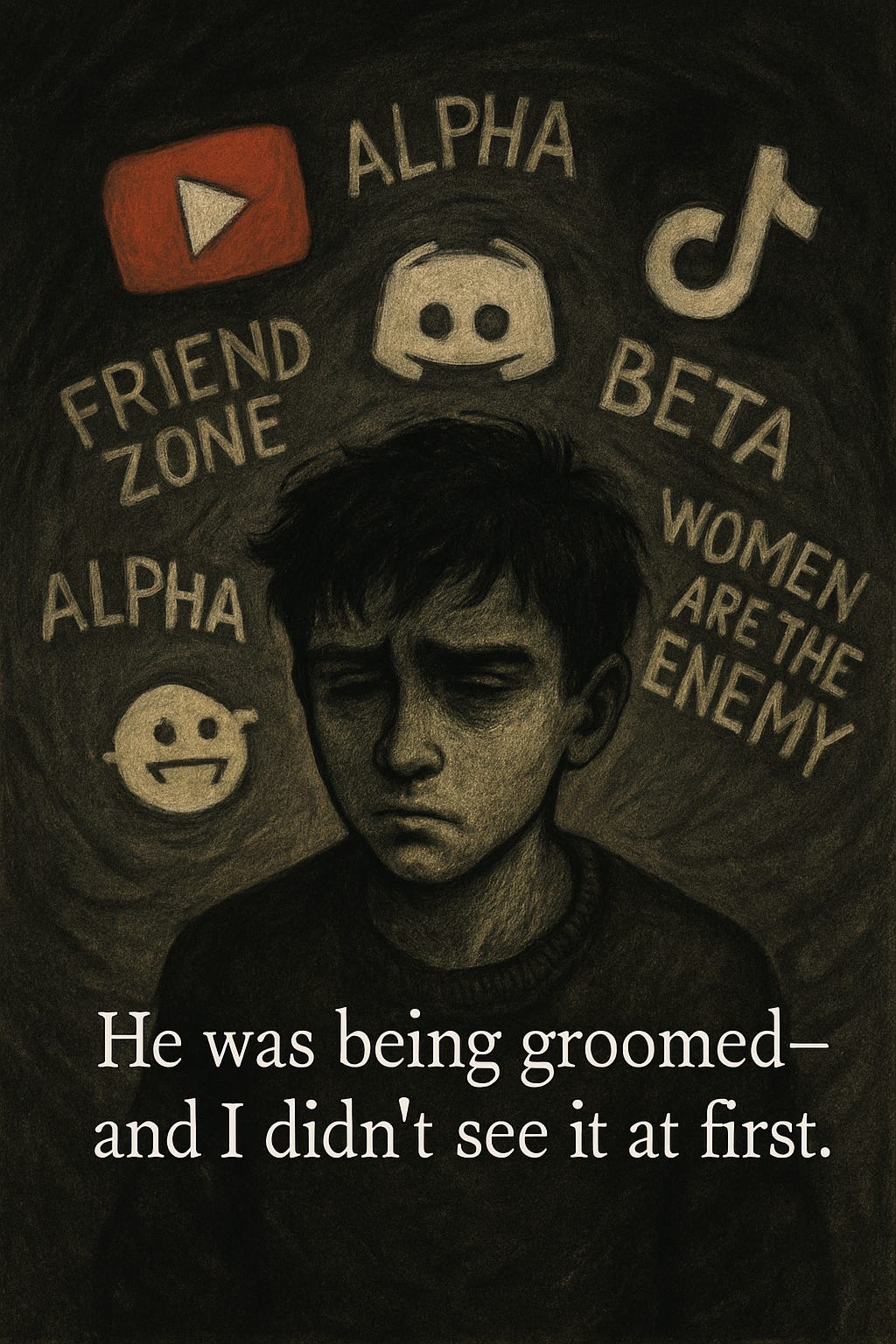
Here. Talk to your kids about these sites and do everything to keep your kids off hem.
1. Incels.co (formerly Incels.me)
Platform: Forum
Profile: Largest active incel community online, notorious for extreme misogyny, violent rhetoric, and links to real-world violence.
Overlap: Uses far-right rhetoric around race, immigration, and anti-feminism, though primarily defined by sexual grievance.
2. Looksmaxxing Forums
Platform: Community boards (Looksmax.org)
Profile: Centers on “improving” physical appearance to escape inceldom. Discussions often devolve into body dysmorphia, misogyny, and nihilism.
Overlap: Promotes toxic masculinity ideals and intersects frequently with alt-right pseudoscience about genetics and race.
3. Men Going Their Own Way (MGTOW)
Platform: Reddit (historically), private forums, Telegram groups
Profile: Men who reject women, relationships, and societal obligations. While officially non-violent, often fuels misogyny and bitterness.
Overlap: Significant overlap with alt-right and white nationalist forums, united by anti-feminist, anti-progressive views.
4. Blackpill Communities
Platform: Reddit (r/BlackPillScience), Telegram, private forums
Adherents think genetics predetermine that success with women. Advocates hopelessness, nihilism, and isolation.
Overlap: Commonly intersects with far-right eugenics, race realism, and pseudoscientific ideas around genetic superiority.
5. Pickup Artist (PUA) Forums
Platform: Various online blogs, Reddit groups, coaching sites
Profile: Predatory tactics to manipulate women, heavily criticized for promoting objectification and coercion. Many incels initially engage here before becoming radicalized further.
Overlap: clear intersection with alt-right notions of dominance, hierarchy, and aggressive masculinity.
2.) Let’s Get Real About Rejection.
I get it. Getting rejected sucks. But we need to tell our kids that it happens to everyone. Rejection doesn’t happen just to them. I try to be upfront about my own failures, jobs I didn’t get, teams I got cut from, friends who bailed on me, girls I liked who didn’t like me back. We need to show our kids that rejection is part of life, not a personal curse. It just means you’re living.
3.) Saturdays are NOT just for the boys.
I see these flags on hanging on influencers backgrounds on social media all the time. I fucking hate them. You hear this phrase a lot on social media: “Saturdays are for the boys.” It’s a harmless rallying cry for friendship and fun. But it can easily turn into toxic echo chambers, especially online!
I push my kids to have OFFLINE friends who are boys, friends who are girls, friends who are neither nor somewhere in between. He should spend time with people who had different upbringings, perspectives, and challenged his definition of “normal”.
That’s one of the best ways to keep someone from falling into incel thinking… exposure. If you actually know girls (not just as a theoretical “other,” but as real, complicated, funny, annoying, wonderful people), it’s a lot harder to turn them into villains in your head. Same goes for any group. The more you see, the more you realize everyone’s just trying to figure things out, just like you.
So in our house, Saturdays aren’t just for the boys. They’re for whoever’s up for a game, a movie, a hike, a meal, whoever brings something new to the table. That’s how you build empathy, and that’s what keeps the worst kinds of resentment from taking root.
4.) Girls Are People, Not Prizes.
You’d think this would be obvious, but a lot of the online incel world is built around the idea that women are some kind of status symbol, a toy you “win” or “deserve.” The message is everywhere, movies, games, social media, even the way adults sometimes talk about crushes or dating. You hear it in phrases like “friend-zoned” or “scoring,” as if being in a relationship is about racking up points, and girls are the trophy at the end.
I make a point of pushing back on that, early and often. With my son, I talk about kindness, genuine kindness, not the kind that expects something in return. We talk about what it means to actually listen to someone, to pay attention to what they’re saying and how they’re feeling, not just waiting for your own turn to talk. When my son tells me about a girl at school, I’ll ask about her interests, her sense of humor, what she’s good at. Not what she looks like.
We talk about respecting boundaries, too. I want him to understand that nobody owes him affection, attention, or a “yes.” Sometimes, people aren’t interested, or they change their minds, and that’s okay. It doesn’t mean something’s wrong with him, and it doesn’t make the other person the villain in his story.
Maybe most important, I remind him that girls can be friends, teammates, rivals, mentors, anything. Their value doesn’t depend on whether he has a crush on them. They’re just people, each carrying around their own messy, complicated, fascinating lives. When you see that, it’s a lot harder to fall into the trap of thinking of women as objects or adversaries.
This isn’t a one-and-done conversation; it’s ongoing. The world keeps sending the opposite message, so I keep sending mine. If he grows up seeing girls as people, not prizes, he’ll be way less likely to fall into the toxic thinking that fuels the incel mindset. And honestly, he’ll just be a better human for it.
5.) GET OFFLINE! Encourage hobbies that aren’t just about winning or impressing.
It sounds small, but this matters. I want my son to try things just for the fun of it, drawing, playing music, cooking, hiking, whatever. Not everything has to be a competition, and not everything has to make you cool. But most importantly, if a child discovers they are good at something, their sense of self-worth explodes. When they discover they are good at something, they feel good about themselves. They discover the payoff of working hard. They feel success! If they want to write their own comic book, I’m taking them to the art store and buying the paper and colored pencils. Want to learn to bake? I’m buying the flour and eggs, so don’t worry about messing up the kitchen. If it brings them joy, it also gives them purpose.
6.) Making Space for REAL Friendships.
Loneliness is at the core of a lot of incel stories. Boys need friends, real ones, not just online avatars. In any chance I try to help my son nurture his friendships, hikes, playdates, sleepovers, hangouts, camping trips. I’m willing to give up whatever plans I have that weekend if it means getting the kids and their friends together for any meaningful activity. We need to encourage them to find mentors, teammates, study buddies, people they can count on.
7.) Debunking Toxic Masculinity (Again and Again and Again)
The old rules about how men are supposed to act die hard. I challenge them whenever I can. We talk about toxic masculinity, what it is, how it hurts everyone, and why it’s okay to be soft, creative, scared, or unsure. I want him to see that strength comes in many shapes.
8.) Letting Him Fail Safely.
It’s tempting to smooth the path, but I try to resist. If my son messes up, I’m there, but I’m not fixing everything for him. He needs to learn that he can survive mistakes and setbacks. That’s how you build real resilience, the kind that keeps you from lashing out at the world when things don’t go your way.
Is this list perfect? Of course not. I’m making it up as I go, like every parent. But I know this: the world is full of angry voices telling boys they’re victims, that they’re owed something, that everyone else is to blame for their unhappiness. My job is to help my son tune those voices out—and maybe, just maybe, become the man who makes the world a little gentler for everyone.
If you’ve got ideas, stories, or worries of your own, drop them in the comments. No one has all the answers, but talking about it is a good place to start.




 DAD BOD WEEKLY