

They aren’t losing faith, they’re redefining it. Today’s teens crave authenticity over ritual, service over sermons, and purpose over pews.

I was raised in a Catholic home. And I loved being a practicing Catholic. Starting in sixth grade I served as an Altar Boy continuing through high school. I sang in the grade school youth choir. When I went away to college I still attended mass. (Before hitting the bars on a Saturday night). Even in my bachelor days I attended Sunday 5:00pm mass. When I married, I switched to the Presbyterian faith. Not because I tired of being Catholic. But I wanted to go to the same church as my wife. The church where she grew up. The church where we were married. I simply switched community of believers.
As our family grew to two kids, they attended the pre-school affiliated with our church. They also attended youth group and mission trips to Mexico to help build housing.
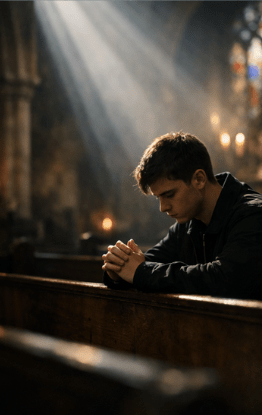
But as they get older, they are now making their own choices. One of those choices is that they don’t want to be part of a church community. We never had a sit down discussion about it. It just happened. And I’m fine with that.
They’re good kids. Kind, thoughtful, curious. They talk about morality, social justice, forgiveness and empathy. They just don’t want to sit in a pew to do it.
So why aren’t kids attending church? A few reasons.
“It doesn’t speak to me.”
Most services still feel like they were built for the parents. The music, the language, the structure, it doesn’t connect. Even the most well intentioned youth services (planed by adults) can feel canned and disconnected from the kids real world.
“It feels performative.”
In an age of social media and AI deep fakes, kids have finely tuned bullshit detectors. When they see when one pastor scandal after another (financial, sexual, political) they question the authenticity of the institution.
Even the mega-church movement is described as “peaked.” The flashy shows and rock band services are unsustainable.

“I’d rather do something.”
This is the main point. Many teens say they’d rather spend time serving meals, cleaning up their community, or mentoring younger kids than sitting through a sermon. They equate faith with action, not attendance.
A Generational Shit: The End of the Church Age
As an elder in my church I did a little research why kids weren’t attending.
It turns my family isn’t alone in this generational shift about church attendance. One Gallup poll reports that only 30% of U.S. adults attend religious services weekly or almost weekly. That’s a 12% decline from 20 years ago. When I look at stats for kids age 18-29, only 22% attend regularly.
But here’s what’s interesting: the belief system itself isn’t shrinking. Most of our kids still have a strong moral compass. It’s the institutions that are shrinking.
My pastor uses the phrase “the end of the church age.” It’s a metaphor to describe the decline of institutional Christianity in the West. Church membership, attendance, and community influence is waning. A church is no longer the central hub of a community. Fewer people see church as the moral center of their lives or communities. So the “church age”, meaning the era when churches held social power, political sway, and default moral authority is effectively ending.
Our kids are finding finding ways to define and express their set of values and life meaning elsewhere; volunteering, environmental work, community activism. They want something that feels real and lived, not just recited. They’re searching for a version that’s less about attendance and more about authenticity.

I think they are equating faith with action, not attendance. And that is actually closer to biblical teaching.
Matthew 25: 35-40 states.
“For I was hungry and you gave me something to eat,
I was thirsty and you gave me something to drink,
I was a stranger and you invited me in,
I needed clothes and you clothed me,
I was sick and you looked after me,
I was in prison and you came to visit me.”
or James 2 14-17 teaches
“What does it profit, my brethren, if someone says he has faith but does not have works? Can faith save him? … Thus also faith by itself, if it does not have works, is dead.”
This is probably the most direct on point: faith without works is dead. In other words, true faith will manifest itself in deeds. I think our kids are looking for more deeds, less sermons. So when we see our kids participating in clothing and food drives, marching for social justice, speaking up against corrupt government policies, or even silently donating cash to a cause, they are practicing their beliefs. Faith and Empathy. It doesn’t feel like faith lost, just faith reimagined.
So I stopped worrying about dragging them back into an old building that smells like grandma’s rosewater. Now I need to find a way to walk with them as they redefine what faith in a changing world means.
I still hope they’ll find a spiritual community someday. Maybe it’ll be a church, maybe it won’t. Maybe it will be a small group of friends. I’ve stopped thinking faith has to fit the mold I grew up with.
The next generation is teaching us something vital: God doesn’t just live in sanctuaries. He’s in the questions, in the doubts, in the messy middle of figuring out what we actually believe, and what we’re going to do about it.
So yes, my kids don’t go to church. And I’m okay with that. Because if faith is real, it’s not fragile. It doesn’t vanish just because it’s missing from the Sunday attendance record.



 DAD BOD WEEKLY