

Douglas Adams’ sci-fi classic is more relevant than ever, helping kids handle anxiety, embrace uncertainty, build resilience, and define their own meaning of life, their own 42
Part 5 in our series, A Curriculum of Dissent

In our “Curriculum of Dissent” series, we explored The Great Gatsby and cornered one man’s obsession with image, false love, and his fatal downfall when authenticity, decency, and empathy are replaced by the chase for status, image, and greed. (Click here to read that post)
In Brave New World, we explored the dangers to our kids as governments and corporations use pleasure as a means of control, distraction to discourage deep critical thinking, and the death of the individual. (Click here to read that post)
In The Catcher in the Rye, we explored Holden Caulfield’s search for empathy and how his search is still very important and relevant to our kids’ lives today. (Click here to read that post)
This week, we’re exploring Douglas Adams’ hilarious and deeply philosophical masterpiece, The Hitchhiker’s Guide to the Galaxy.
Side note: As a high-strung, stressed-out college freshman, a student in the middle of the night walked our entire dorm and placed large, round yellow stickers on every room door. The sticker simply had two words in bold blue lettering: DON’T PANIC. At the time, I didn’t get it. I just thought our hall was vandalized. But after talking to some of my dorm hall buddies, I learned what the stickers meant. A quick trip to the bookstore and I picked up my own copy. I am not exaggerating when I tell you, from that point on, my life philosophy changed for the better. This is the book that tells you the most important thing you need to know about navigating the 21st century and all of its gaslighting, corruption-filled, status-obsessed, anxiety-fueling absurdity:
Don’t Panic.
If it’s been a while since you read the book, or you’ve never picked it up, here’s what you need to know: Douglas Adams’ first book of a four-book trilogy was first released in book form in 1979. The story begins on the morning the Earth is destroyed. Our main character, Arthur Dent, is an ordinary Englishman trying to save his house from demolition, a victim of government incompetence and bureaucracy.
Arthur’s longtime friend, Ford Prefect, arrives at Arthur’s house and tells him not to worry about the house. There are bigger problems right now. Ford reveals he’s actually an alien from another planet. Ford tells Arthur that Earth is about to be destroyed to make way for an off-ramp of a hyperspace highway. Earth is a victim of government incompetence and bureaucracy. (See the absurdity?)
Seconds before Earth explodes, Ford rescues Arthur by hitchhiking onto a passing spaceship, and suddenly Arthur is thrust into an endless universe, filled with increasingly absurd adventures while searching for meaning in a cosmos that makes no sense. As Arthur and Ford explore the universe looking for the meaning of life, they continually arrive at the puzzling answer: 42.
The book’s central joke, and its deepest truth, comes when a cosmic supercomputer reveals that the answer to life, the universe, and everything is simply “42.” The problem is that nobody understands that answer. Adams uses comedy and science fiction to explore what happens when we stop demanding life spoon feed us answers and instead start creating our own meaning.
So why is this book so important, especially forty-six years after its release? Because if there’s one thing we know as parents, it’s that our kids are growing up in a world that is determined to cram their lives into rigid little boxes. Schedules. Sports, Tests, Metrics. Rubrics. College admissions checklists. Everything neat, tidy, predictable. But in reality life shows up like a bulldozer and says:
“Sorry kid, life is unpredictable. Adapt.”
The first, most vital lesson the book and series teach our kids is that life is not a predictable structure; it’s a chaotic adventure. Change has happened. Change is here. And change is coming in the future. There is no way to avoid it. The people who get through it happy and healthy are those who can work with the change.
Let’s talk about 42 and the meaning of life.
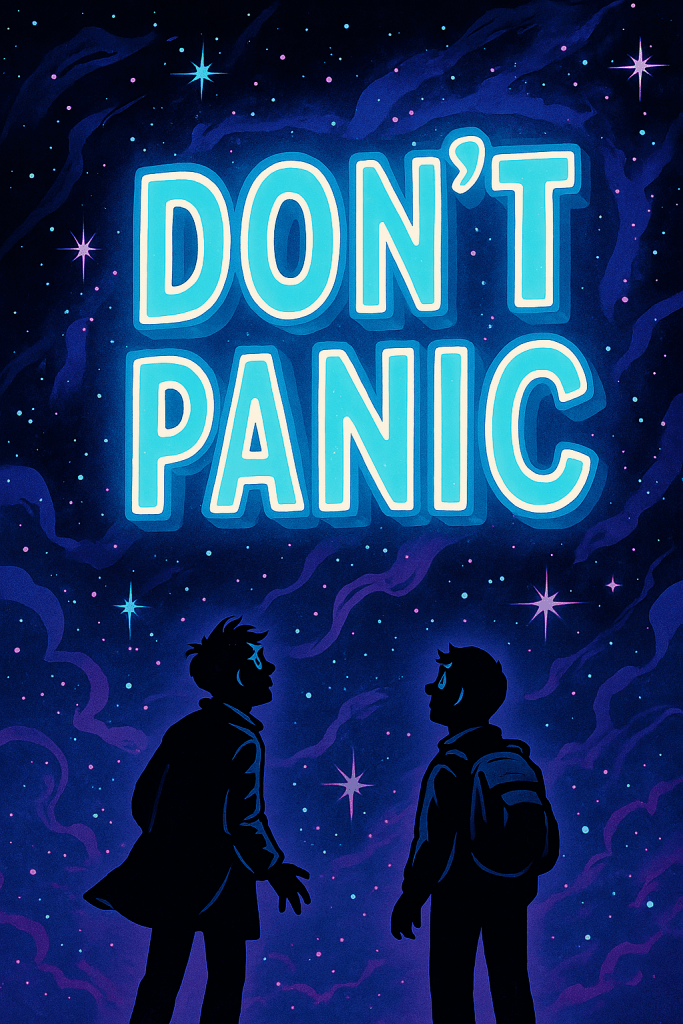
Meaning, purpose, empathy, sympathy, authenticity, and bravery are the most essential tools our kids need to survive today’s gaslighting, deep faking, image-chasing, status-loving world.
So what does 42 have to do with it? This is where Douglas Adams was brilliant. In the early days of computing, 42 acted as a placeholder in code. It’s a variable that can stand in for anything you want to add in later. When residents ask the supercomputer, “What’s the meaning of life?” it simply answers 42. Adams is telling us the answer is arbitrary.
The meaning of life is whatever you want it to be.
For our kids, they need to learn how to define their own meaning of life, one they can thrive in long after we’re gone.
Maybe their meaning of life is service
(“I want to leave the world a better place than I found it”).
Maybe their meaning of life is intimacy.
(“I just want to find someone I can spend my life with and we can be happy.”)
Maybe their meaning of life is human connection.
(“I want to be a part of a community”).
The book teaches us that the question (and the act of asking questions) is far more important than the answer. It tells us that the true meaning of life is something that is to be discovered out there (even if it means leaving our comfortable country house like Arthur Dent did). The book tells us the meaning of life is something to be discovered on your own, not assigned by an outside force.
Let’s talk about anxiety.
The Hitchhiker’s Guide to the Galaxy gives us permission to stop taking life so seriously. Yes, we have problems. Yes, we have goals. Yes, living in today’s digital, modern, social media world is the direct cause of anxiety and stress. But The Hitchhiker’s Guide to the Galaxy slaps it all back into perspective like a comedic wet fish to the face.
The book teaches our kids:
Yes, plan, but don’t worry about the plan. It’s going to change. Allen Saunders said it best: “Life is what happens to us while we are making other plans.” If our kids are equipped to handle change, they’ll thrive.
Define your own meaning. No one else can give you your 42. This is the very essence of being a happy, healthy individual. My 42 may be very different from my son’s and daughter’s 42. And that’s OK. As long as their 42 makes them happy, healthy, and doesn’t harm others.
Enjoy the challenges. As parents, we want our kids’ paths to be straight and safe. As parents, we tend to over-engineer certainty, charts, schedules, structure.
But that’s not real life. Yes, life is hard. Yes, there will be challenges every step of the way on your life adventure. But Adams is telling us that we need to find our way of coping. That can be in the form of a friend group. It can be in the form of having a third place to get away and decompress (I wrote about the need for third spaces here). The book reminds us that life is an adventure, not an itinerary. And every setback is an invitation to improvise. And improvisation can lead to unexpected joy.
The universe is filled with weird people. And that’s what makes it so fun. Throughout the book, we meet a cast of characters that are absurd and quirky, from two-headed renegade space pirates, to depressed robots, to process-obsessed bureaucrats. But they all have value, and they all serve a purpose. The entire cast is a lesson in embracing difference.
And that’s where we, as parents, also get challenged. We coach our kids to fit in, worry when they are quirky, and we correct their weird little interests. If we want kids who accept others we need to stop trimming their own oddities.
We’re raising our kids in a world that is heavy, structured, and over-curated. But outside that door, it’s chaotic as hell. But The Hitchhiker’s Guide to the Galaxy shows kids (and us) that survival (true happiness), adaptability, curiosity, playfulness, meaning, and a sense of humor matter most.
It’s asking our kids to enjoy the ride, stay flexible when the road shifts, and build their own 42 as they go.
If we can raise kids who don’t panic, then maybe we’ve taught them the one thing no curriculum teaches:
The courage to not just survive their journey, but enjoy it.




 DAD BOD WEEKLY