

New UC San Diego data and national test scores reveal a crisis in literacy, math, problem-solving, and critical thinking. Here’s what every parent needs to know before their kid falls behind.

Graphic showing a sharp increase in UC San Diego students needing remedial math.

Social media, especially Tok Tok, is buzzing about a new report from UC San Diego. The report revealed that nearly one in eight college first-year students, students who were accepted into a major university, cannot do math at a third grade level. But the scariest part of the report is that many of these kids graduated from high school with A-minus averages.

For a little context, for Fall 2025, UC San Diego had an acceptance rate of 28.4% (38,846 admitted out of 136,728 applicants). 100% of admitted students come from the top 10% of their high school class, and the average GPA is over 4.0 The average GPA range for admitted students is 4.10 to 4.28

UC San Diego is ranked #29 in National Universities and #6 in Top Public Schools by U.S. News.

How bad is the problem?
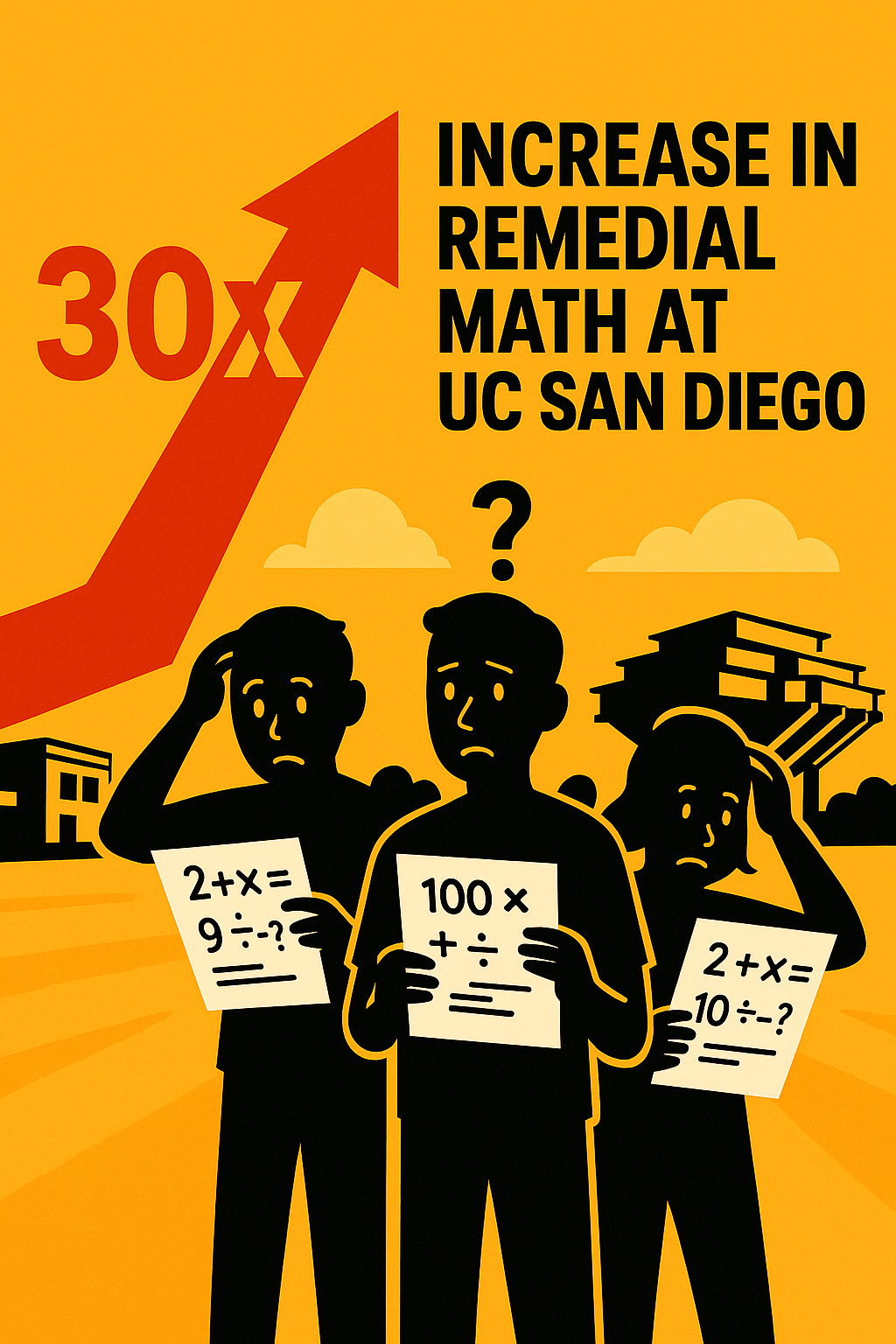
Graphic showing a sharp increase in UC San Diego students needing remedial math.

Between 2020 and 2025, UC San Diego watched their incoming freshmen’s math skills crater. The number of students whose abilities fell below middle-school level didn’t just increase, it exploded thirtyfold, jumping from under 1% to 11.8% of incoming students.

We’re not talking about struggling with calculus or trigonometry. In fall 2025, 921 freshmen enrolled in remedial courses covering elementary and middle school material. Some couldn’t answer “7 + 2 = ___ + 6.” Others failed to round 374,518 to the nearest hundred.

The most gut-wrenching detail? Among students in the most remedial math course, the average high school GPA was 3.65. A quarter of them had perfect 4.0 GPAs.

Read that again. Straight-A students who can’t do elementary school math.

This Isn’t Just a San Diego Problem

This crisis is nationwide, and the statistics are damning.

Reading: We’re Failing Literacy

The 2024 National Assessment of Educational Progress delivered a gut-punch: reading scores for 12th graders hit their lowest level since testing began in 1992Only 35% of high school seniors can read at a proficient level. Nearly a third, 32%, score below basic proficiency, meaning they struggle to locate and identify details in a text to understand its meaning.

Think about that. In the age of information, a third of our graduating seniors can’t reliably understand what they read.

Math: The Numbers Don’t Lie
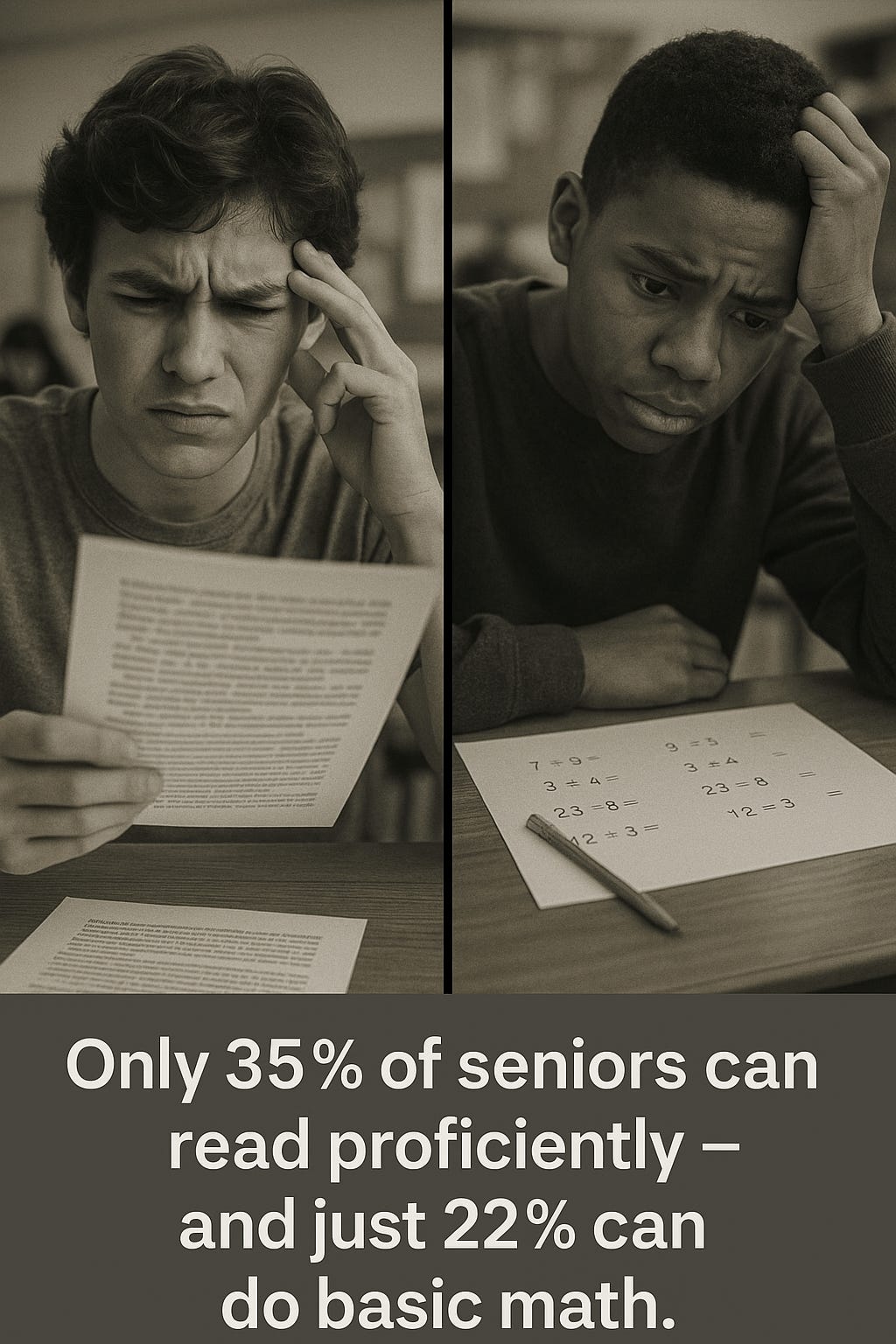
Teens struggling with reading and basic math in a classroom setting.

This Substack is reader-supported. To receive new posts and support my work, consider becoming a free or paid subscriber.

Only 22% of 12th graders performed at or above ability in math on the 2024 NAEP. That means 78% of high school seniors are not proficient in mathematics.

The situation is so dire that 45% scored below basic achievement, the highest percentage since 2005. And only 33% were considered academically prepared for college-level math, down from 37% in 2019.

Problem-Solving: The Skills Employers Actually Need

Nearly 90% of employers say they’re looking for people with proven problem-solving skills. It’s one of the most valued attributes in the job market, with 82.9% of employers rating it as highly important.

So how are we preparing our kids for this reality? Not well. The math scores tell part of the story, but the problem runs deeper. Our kids aren’t just struggling with equations, they’re struggling to think through challenges systematically.

Critical Thinking is Becoming Extinct
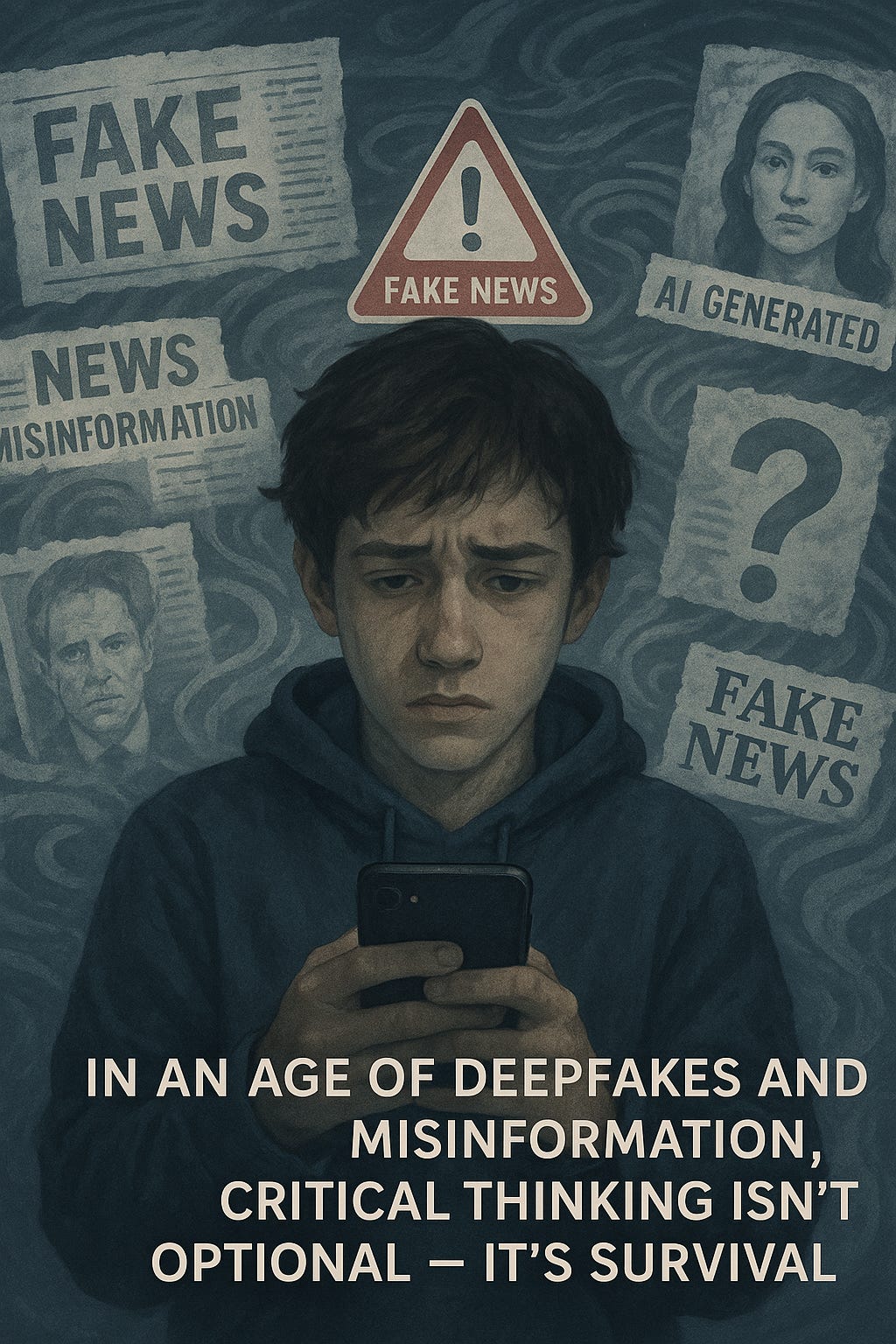
The statistics here are embarrassing:

  • Only 16% of U.S. high schools offer dedicated courses in critical thinking
  • Just 37% of students report being explicitly taught critical thinking skills
  • 60% of teachers believe students lack critical thinking skills
  • 72% of young adults feel unprepared to evaluate news sources critically
  • 69% of recent graduates feel their education didn’t adequately prepare them for real-world problem solving

A Stanford study revealed that 93% of college students couldn’t recognize that a lobbyist website was biased. Fewer than 20% of high-schoolers understood that a single online photo doesn’t prove something occurred.

We’re raising a generation that can’t tell facts from fiction, can’t evaluate sources, and can’t think critically about the information flooding their phones every single day.

How did we get here?

UC San Diego’s report points to several culprits:

The COVID Effect: Pandemic closures devastated learning, and we’re still dealing with the fallout five years later.

The Testing Exodus: Many schools cut standardized testing requirements, removing one of the few objective measures of student achievement.

Grade Inflation on Steroids: When a student with a 4.0 GPA can’t round to the nearest hundred, grades have become meaningless. Schools are handing out A’s like participation trophies, and colleges, who desperately need tuition dollars are accepting students they know aren’t prepared.

Under-Resourced Schools: As universities expanded admissions from struggling school systems (often with good intentions), they discovered these students arrived without basic skills. But the blame doesn’t lie with the students—it lies with a system that failed to prepare them.

What does this mean for our kids?

If you’re a dad with school-age kids, this should be a five-alarm fire. Here’s what we’re looking at:

College readiness backlash: Your kid might graduate from high school with honors, get accepted to a university, pay tuition, and then discover they need to take remedial courses that don’t even count toward their degree. You’re paying college prices for middle-school content.

The job market reality: Employers aren’t lowering their standards. They still need people who can solve problems, think critically, and do basic math. If schools aren’t teaching these skills, your kids will hit a wall the moment they enter the workforce.

The information war: In an age of deepfakes, misinformation, and AI-generated content, critical thinking isn’t optional, it’s survival. And we’re sending kids into this world unable to evaluate whether what they’re seeing is real.

We’re in the middle of an education crisis that most parents don’t even realize is happening. Report cards look great. Kids are getting into college. Everything seems fine.

But it’s not fine. We’re graduating students who can’t read proficiently, can’t do basic math, can’t solve problems, and can’t think critically. We’re sending them into a world that demands all of these skills and more.

The UC San Diego report isn’t just about one university or one state. It’s a warning shot. Our kids are competing in a global economy, and we’re not preparing them for the fight.

So yeah, this got heavy. But our kids are being let down. The hard fact is they are being let down by us. If we’re not involved in our kid’s education, we’re enabling the downward slide.

The question is: what are we going to do about it?

What do you think? Are you seeing this with your own kids? Let us know in the comments. And if this article made you uncomfortable, good. Share it with other parents who need to hear it.



New UC San Diego data and national test scores reveal a crisis in literacy, math, problem-solving, and critical thinking. Here’s what every parent needs to know before their kid falls behind.

Graphic showing a sharp increase in UC San Diego students needing remedial math.

Social media, especially Tok Tok, is buzzing about a new report from UC San Diego. The report revealed that nearly one in eight college first-year students, students who were accepted into a major university, cannot do math at a third grade level. But the scariest part of the report is that many of these kids graduated from high school with A-minus averages.

For a little context, for Fall 2025, UC San Diego had an acceptance rate of 28.4% (38,846 admitted out of 136,728 applicants). 100% of admitted students come from the top 10% of their high school class, and the average GPA is over 4.0 The average GPA range for admitted students is 4.10 to 4.28

UC San Diego is ranked #29 in National Universities and #6 in Top Public Schools by U.S. News.

How bad is the problem?

Graphic showing a sharp increase in UC San Diego students needing remedial math.

Between 2020 and 2025, UC San Diego watched their incoming freshmen’s math skills crater. The number of students whose abilities fell below middle-school level didn’t just increase, it exploded thirtyfold, jumping from under 1% to 11.8% of incoming students.

We’re not talking about struggling with calculus or trigonometry. In fall 2025, 921 freshmen enrolled in remedial courses covering elementary and middle school material. Some couldn’t answer “7 + 2 = ___ + 6.” Others failed to round 374,518 to the nearest hundred.

The most gut-wrenching detail? Among students in the most remedial math course, the average high school GPA was 3.65. A quarter of them had perfect 4.0 GPAs.

Read that again. Straight-A students who can’t do elementary school math.

This Isn’t Just a San Diego Problem

This crisis is nationwide, and the statistics are damning.

Reading: We’re Failing Literacy

The 2024 National Assessment of Educational Progress delivered a gut-punch: reading scores for 12th graders hit their lowest level since testing began in 1992Only 35% of high school seniors can read at a proficient level. Nearly a third, 32%, score below basic proficiency, meaning they struggle to locate and identify details in a text to understand its meaning.

Think about that. In the age of information, a third of our graduating seniors can’t reliably understand what they read.

Math: The Numbers Don’t Lie

Teens struggling with reading and basic math in a classroom setting.

This Substack is reader-supported. To receive new posts and support my work, consider becoming a free or paid subscriber.

Only 22% of 12th graders performed at or above ability in math on the 2024 NAEP. That means 78% of high school seniors are not proficient in mathematics.

The situation is so dire that 45% scored below basic achievement, the highest percentage since 2005. And only 33% were considered academically prepared for college-level math, down from 37% in 2019.

Problem-Solving: The Skills Employers Actually Need

Nearly 90% of employers say they’re looking for people with proven problem-solving skills. It’s one of the most valued attributes in the job market, with 82.9% of employers rating it as highly important.

So how are we preparing our kids for this reality? Not well. The math scores tell part of the story, but the problem runs deeper. Our kids aren’t just struggling with equations, they’re struggling to think through challenges systematically.

Critical Thinking is Becoming Extinct

The statistics here are embarrassing:

  • Only 16% of U.S. high schools offer dedicated courses in critical thinking
  • Just 37% of students report being explicitly taught critical thinking skills
  • 60% of teachers believe students lack critical thinking skills
  • 72% of young adults feel unprepared to evaluate news sources critically
  • 69% of recent graduates feel their education didn’t adequately prepare them for real-world problem solving

A Stanford study revealed that 93% of college students couldn’t recognize that a lobbyist website was biased. Fewer than 20% of high-schoolers understood that a single online photo doesn’t prove something occurred.

We’re raising a generation that can’t tell facts from fiction, can’t evaluate sources, and can’t think critically about the information flooding their phones every single day.

How did we get here?

UC San Diego’s report points to several culprits:

The COVID Effect: Pandemic closures devastated learning, and we’re still dealing with the fallout five years later.

The Testing Exodus: Many schools cut standardized testing requirements, removing one of the few objective measures of student achievement.

Grade Inflation on Steroids: When a student with a 4.0 GPA can’t round to the nearest hundred, grades have become meaningless. Schools are handing out A’s like participation trophies, and colleges, who desperately need tuition dollars are accepting students they know aren’t prepared.

Under-Resourced Schools: As universities expanded admissions from struggling school systems (often with good intentions), they discovered these students arrived without basic skills. But the blame doesn’t lie with the students—it lies with a system that failed to prepare them.

What does this mean for our kids?

If you’re a dad with school-age kids, this should be a five-alarm fire. Here’s what we’re looking at:

College readiness backlash: Your kid might graduate from high school with honors, get accepted to a university, pay tuition, and then discover they need to take remedial courses that don’t even count toward their degree. You’re paying college prices for middle-school content.

The job market reality: Employers aren’t lowering their standards. They still need people who can solve problems, think critically, and do basic math. If schools aren’t teaching these skills, your kids will hit a wall the moment they enter the workforce.

The information war: In an age of deepfakes, misinformation, and AI-generated content, critical thinking isn’t optional, it’s survival. And we’re sending kids into this world unable to evaluate whether what they’re seeing is real.

We’re in the middle of an education crisis that most parents don’t even realize is happening. Report cards look great. Kids are getting into college. Everything seems fine.

But it’s not fine. We’re graduating students who can’t read proficiently, can’t do basic math, can’t solve problems, and can’t think critically. We’re sending them into a world that demands all of these skills and more.

The UC San Diego report isn’t just about one university or one state. It’s a warning shot. Our kids are competing in a global economy, and we’re not preparing them for the fight.

So yeah, this got heavy. But our kids are being let down. The hard fact is they are being let down by us. If we’re not involved in our kid’s education, we’re enabling the downward slide.

The question is: what are we going to do about it?

What do you think? Are you seeing this with your own kids? Let us know in the comments. And if this article made you uncomfortable, good. Share it with other parents who need to hear it.
Leave a comment