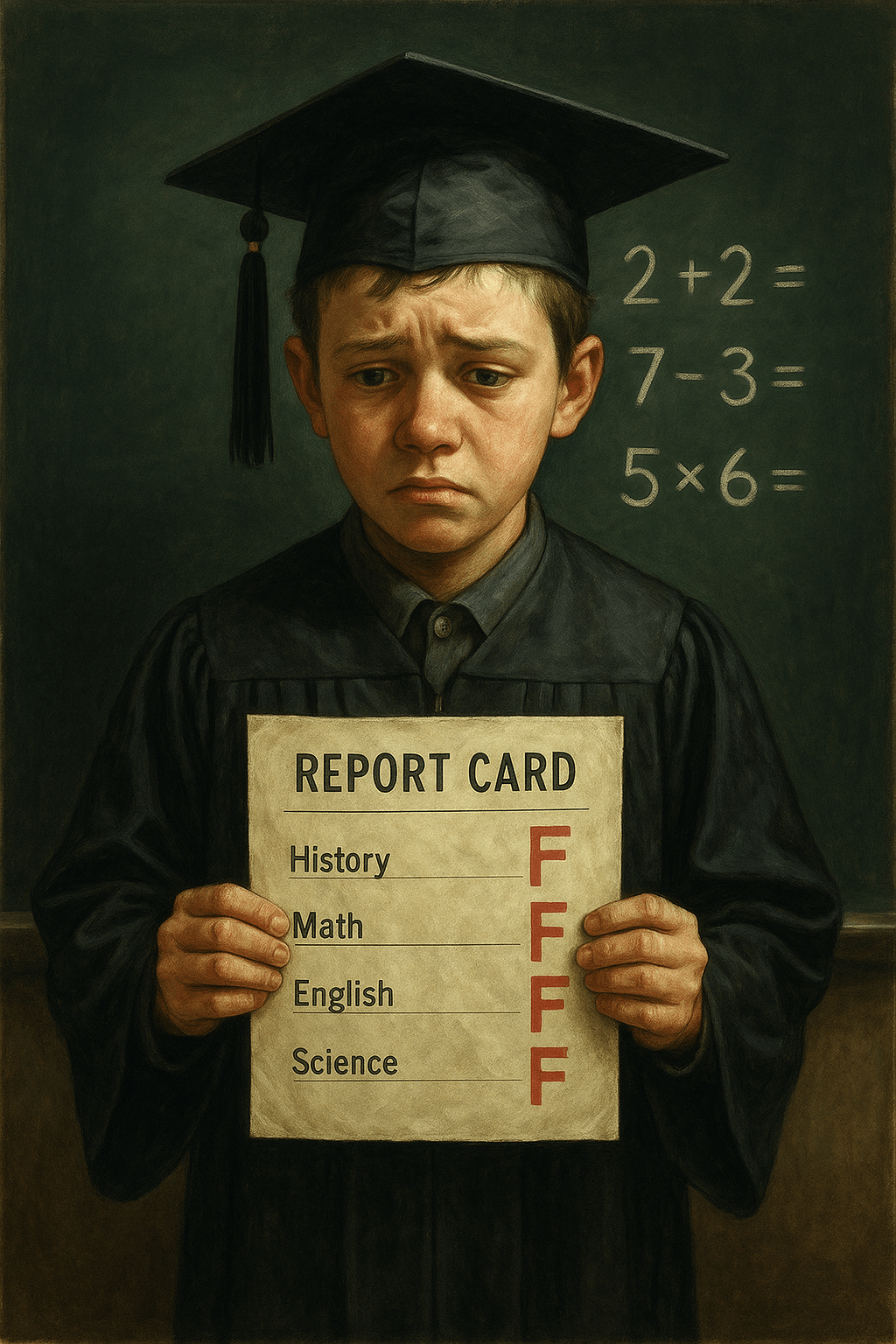
A middle-school student in a graduation cap holds a report card with failing grades while standing in front of a chalkboard filled with unanswered basic math problems.

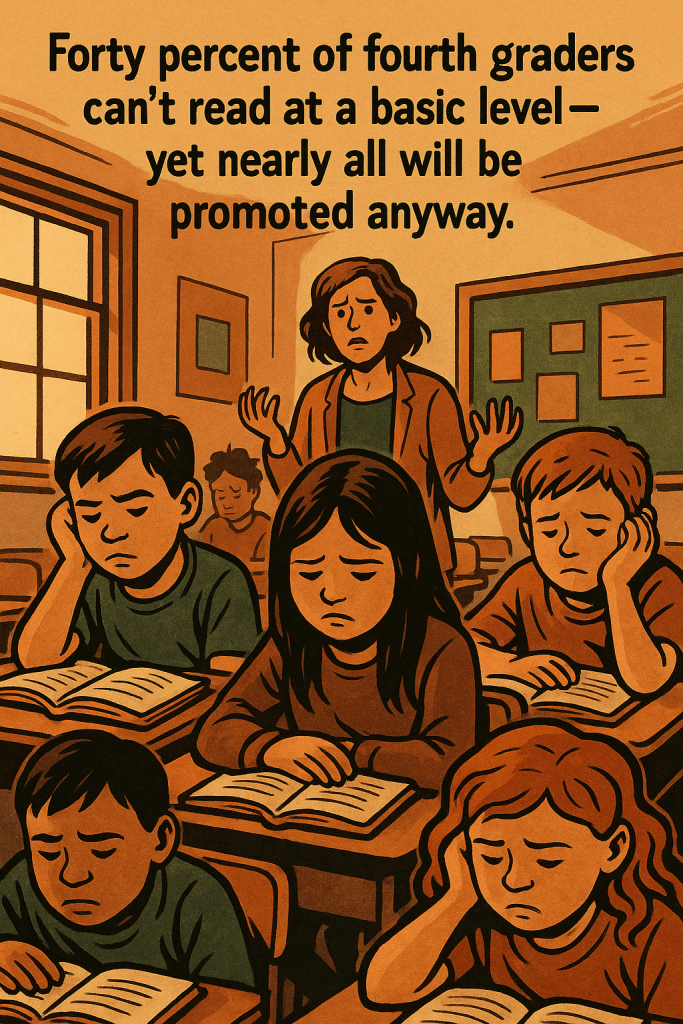
Forty percent of fourth graders can’t read at a basic level. Yet we keep pushing them forward. Real accountability, not automatic promotion, is how we fix this mess.
Here is a fun little horror story.

About 25 percent of young adults in America are functionally illiterate.
Read that again. A quarter of our kids cannot read well enough to function in daily life.

Now the plot twist.


More than half of that same group still graduated high school. We are literally handing out diplomas like party favors. Meanwhile the kids who earned them cannot read the instructions on the box. If this feels insane, that is because it is.

For years, schools have used two main ways to move kids from grade to grade: either hold them back if they’re behind (“retention”) or push everyone ahead no matter what (“social promotion”). 

So, what’s the difference? Social promotion means students pass to the next grade even if they haven’t mastered the basics. The thinking here is that it helps kids stick with their age group, keeps their self-esteem intact, and gives them a chance to soak up good habits from classmates who are doing better. 

It sounds good in theory, right? Some teachers and advocates refer to this as “lifting”, hoping that struggling students will learn from their more successful peers. The hope is that these kids will see what it takes to do well and start to copy it. 

But here’s what actually happens: Everyone realizes you don’t really have to try. If you know you’ll move up no matter how much you learn, why work harder? Even strong students learn there’s no real penalty for slacking off, so motivation drops for the entire group. The bar gets lowered, and everyone loses: less learning, less responsibility, less drive to start things on your own. Social promotion teaches everyone the same lesson.

Nothing matters. 
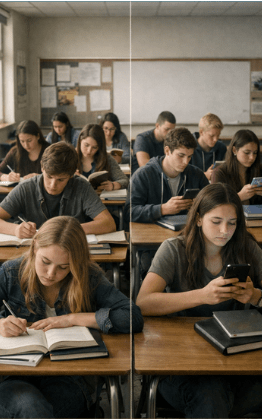
If you know you will pass whether you try or not, why try. Kids are not dumb. They do not grind through flashcards or textbook chapters for fun. They work hard when the work matters. They slack when it does not.

And the system keeps telling them it does not.

Even the good students figure it out. They see friends move up despite bombing tests and ignoring homework. Pretty soon the message is loud and clear. Effort is optional. Results do not matter. Being prepared is for suckers.

Then the bar drops.

Kids pick up on something else, too: their teachers and schools won’t really hold them accountable. Too often, parents blame the teachers instead of helping their own kids build better study habits. Parents jump in at this point. Not to help. To blame.

“He is struggling because the teacher does not understand him.”
“She is behind because the assignments are unfair.”

“My child needs support not consequences.”

No. Your child needs consequences.
Most kids do.
Adults do too.

This is why your twelve year old cannot multiply fractions and your sixteen year old cannot read a bus schedule.

As parents, we have to face this. Sometimes, helping our kids succeed long-term means making some tough choices, even if it means your child needs to stay in the same grade another year. It sounds harsh, but promoting a kid who can’t read well or do basic math isn’t helping them. The next year just gets harder, and the foundation’s still shaky. 

Here’s what the numbers show.  According to the National Assessment of Educational Progress, basically America’s report card,

Forty percent of fourth graders cannot read at a basic level.
Not poetry. Not Shakespeare. Basic reading. As in “what does this paragraph say.

One in three eighth graders also cannot read at a basic level.
We are talking about thirteen year olds who cannot identify the main idea in a short passage.

These are the lowest reading scores in decades. But wait. It gets better.

And here’s the kicker: this early learning gap doesn’t just vanish. In 2024, reports showed that about two-thirds of community college students and 40% of students at four-year colleges had to take remedial, non-credit courses when they arrived. In other words, they had a diploma, but they weren’t ready for college-level work. 

When these kids graduate and head to college, guess what happens.
A massive chunk get dumped into remedial classes. These are non credit classes that reteach middle school material because high school did not.

  • About two thirds of community college students need remedial help.
  • About forty percent of four year college students do too.
  • In California, twenty two percent of first time students were taking remedial math.

Remedial math. After high school. After a diploma that said they were ready.

Think about it: these are kids who “passed” high school, with decent GPAs even. But when they got to college,  a big chunk couldn’t handle math or writing. California found that before recent reforms, 22% of first-time community college students took remedial math in 2019. 

So, yes, lots of students show up at college with transcripts that say “ready,” but their skills are still at a middle school level. 

That’s why going back to retention, asking students to repeat a grade if they haven’t mastered the material, makes sense. The idea is simple: don’t move on until you actually get it. Give kids an extra year to fill the gaps and truly catch up. 

But, parents panic. Teachers freeze. Administrators want the drama to go away. Everyone imagines the worst case scenario. A crying kid. A ruined self esteem. A future in shambles.

Here is what actually happens when you do retention the right way, especially in the early grades.

Kids catch up.

Kids build real skills instead of limping along with fake ones.

Kids actually enter middle school ready instead of hoping no one notices what they cannot do.

States like Florida and Indiana proved it.
Retaining struggling readers in the early years (K through 3) led to real academic gains that lasted for years. Not months. Years.

And here is the biggest win.

Kids who were retained early ended up needing fewer catch up classes in high school. They earned better grades than the kids who got waved through.

Retention works when it comes with support and real teaching.
Social promotion works when your goal is pretending everything is fine.

It’s about long-term foundations, not short-term feel-good moments. With social promotion, everyone gets a quick win: you move up a grade, parents feel relief, and the problem’s hidden for another year. But with retention, you tackle the hard stuff early, and that when real solutions can begin. It’s a chance to see what’s really getting in your child’s way, maybe it’s a learning challenge, problems at home, or a need for extra help. 

Research backs this up, especially in the early grades. States like Florida and Indiana found that keeping struggling students in the early years (K-3) led to real, lasting gains in reading and math for up to five years. 

The retention model teaches that your effort matters, and there are consequences if you don’t meet standards. It also pushes schools to step in and give the help kids actually need, instead of just moving the problem along. 

And down the road? Kids who were retained, especially early, end up needing fewer catch-up classes in high school and get better grades compared to those who were just passed ahead. 

It’s a tough conversation, but if we want to set our kids up for real success, we have to make the hard call.


Forty percent of fourth graders can’t read at a basic level. Yet we keep pushing them forward. Real accountability, not automatic promotion, is how we fix this mess.

Here is a fun little horror story.

About 25 percent of young adults in America are functionally illiterate.
Read that again. A quarter of our kids cannot read well enough to function in daily life.

Now the plot twist.


More than half of that same group still graduated high school. We are literally handing out diplomas like party favors. Meanwhile the kids who earned them cannot read the instructions on the box. If this feels insane, that is because it is.

For years, schools have used two main ways to move kids from grade to grade: either hold them back if they’re behind (“retention”) or push everyone ahead no matter what (“social promotion”). 

So, what’s the difference? Social promotion means students pass to the next grade even if they haven’t mastered the basics. The thinking here is that it helps kids stick with their age group, keeps their self-esteem intact, and gives them a chance to soak up good habits from classmates who are doing better. 

It sounds good in theory, right? Some teachers and advocates refer to this as “lifting”, hoping that struggling students will learn from their more successful peers. The hope is that these kids will see what it takes to do well and start to copy it. 

But here’s what actually happens: Everyone realizes you don’t really have to try. If you know you’ll move up no matter how much you learn, why work harder? Even strong students learn there’s no real penalty for slacking off, so motivation drops for the entire group. The bar gets lowered, and everyone loses: less learning, less responsibility, less drive to start things on your own. Social promotion teaches everyone the same lesson.

Nothing matters. 

If you know you will pass whether you try or not, why try. Kids are not dumb. They do not grind through flashcards or textbook chapters for fun. They work hard when the work matters. They slack when it does not.

And the system keeps telling them it does not.

Even the good students figure it out. They see friends move up despite bombing tests and ignoring homework. Pretty soon the message is loud and clear. Effort is optional. Results do not matter. Being prepared is for suckers.

Then the bar drops.

Kids pick up on something else, too: their teachers and schools won’t really hold them accountable. Too often, parents blame the teachers instead of helping their own kids build better study habits. Parents jump in at this point. Not to help. To blame.

“He is struggling because the teacher does not understand him.”
“She is behind because the assignments are unfair.”

“My child needs support not consequences.”

No. Your child needs consequences.
Most kids do.
Adults do too.

This is why your twelve year old cannot multiply fractions and your sixteen year old cannot read a bus schedule.

As parents, we have to face this. Sometimes, helping our kids succeed long-term means making some tough choices, even if it means your child needs to stay in the same grade another year. It sounds harsh, but promoting a kid who can’t read well or do basic math isn’t helping them. The next year just gets harder, and the foundation’s still shaky. 

Here’s what the numbers show.  According to the National Assessment of Educational Progress, basically America’s report card,

Forty percent of fourth graders cannot read at a basic level.
Not poetry. Not Shakespeare. Basic reading. As in “what does this paragraph say.

One in three eighth graders also cannot read at a basic level.
We are talking about thirteen year olds who cannot identify the main idea in a short passage.

These are the lowest reading scores in decades. But wait. It gets better.

And here’s the kicker: this early learning gap doesn’t just vanish. In 2024, reports showed that about two-thirds of community college students and 40% of students at four-year colleges had to take remedial, non-credit courses when they arrived. In other words, they had a diploma, but they weren’t ready for college-level work. 

When these kids graduate and head to college, guess what happens.
A massive chunk get dumped into remedial classes. These are non credit classes that reteach middle school material because high school did not.

  • About two thirds of community college students need remedial help.
  • About forty percent of four year college students do too.
  • In California, twenty two percent of first time students were taking remedial math.

Remedial math. After high school. After a diploma that said they were ready.

Think about it: these are kids who “passed” high school, with decent GPAs even. But when they got to college,  a big chunk couldn’t handle math or writing. California found that before recent reforms, 22% of first-time community college students took remedial math in 2019. 

So, yes, lots of students show up at college with transcripts that say “ready,” but their skills are still at a middle school level. 

That’s why going back to retention, asking students to repeat a grade if they haven’t mastered the material, makes sense. The idea is simple: don’t move on until you actually get it. Give kids an extra year to fill the gaps and truly catch up. 

But, parents panic. Teachers freeze. Administrators want the drama to go away. Everyone imagines the worst case scenario. A crying kid. A ruined self esteem. A future in shambles.

Here is what actually happens when you do retention the right way, especially in the early grades.

Kids catch up.

Kids build real skills instead of limping along with fake ones.

Kids actually enter middle school ready instead of hoping no one notices what they cannot do.

States like Florida and Indiana proved it.
Retaining struggling readers in the early years (K through 3) led to real academic gains that lasted for years. Not months. Years.

And here is the biggest win.

Kids who were retained early ended up needing fewer catch up classes in high school. They earned better grades than the kids who got waved through.

Retention works when it comes with support and real teaching.
Social promotion works when your goal is pretending everything is fine.

It’s about long-term foundations, not short-term feel-good moments. With social promotion, everyone gets a quick win: you move up a grade, parents feel relief, and the problem’s hidden for another year. But with retention, you tackle the hard stuff early, and that when real solutions can begin. It’s a chance to see what’s really getting in your child’s way, maybe it’s a learning challenge, problems at home, or a need for extra help. 

Research backs this up, especially in the early grades. States like Florida and Indiana found that keeping struggling students in the early years (K-3) led to real, lasting gains in reading and math for up to five years. 

The retention model teaches that your effort matters, and there are consequences if you don’t meet standards. It also pushes schools to step in and give the help kids actually need, instead of just moving the problem along. 

And down the road? Kids who were retained, especially early, end up needing fewer catch-up classes in high school and get better grades compared to those who were just passed ahead. 

It’s a tough conversation, but if we want to set our kids up for real success, we have to make the hard call.

Leave a comment