A generation raised on algorithms, test scores, and instant answers is losing the ability to explore, imagine, and wonder. It’s time to fight back.
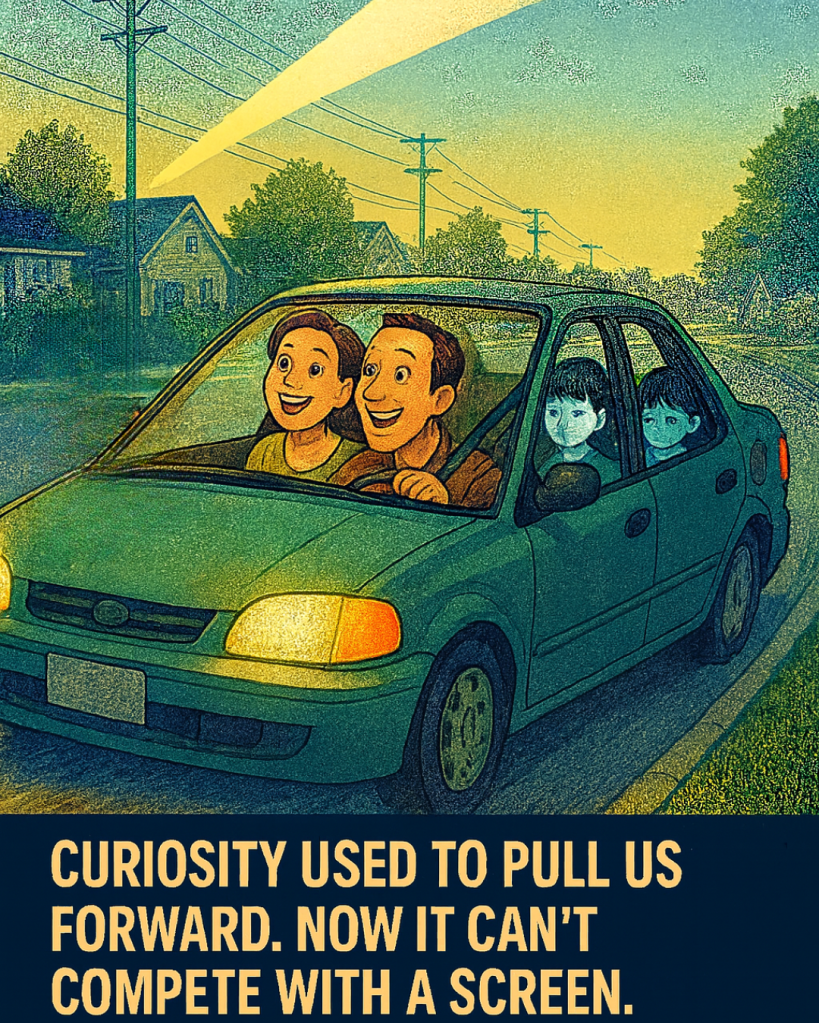
I have this annoying habit when I am driving around our city. It’s come to the point where my kids are nervous about getting in the car with me at night.
So, what is my habit? Whenever I spot a searchlight beaming into the sky, I have to track down its source. I don’t care if it’s a new car dealership opening or a special at the fried chicken joint; we’re going to find where that light is originating from. These impromptu excursions sometimes take us as far as 20 miles from home, with my kids inevitably along for the ride. I’ve been late for dinners, parties, and restaurant reservations. I’ve kept the family trapped in the car far past their bedtime after a long day.
But I’ve also seen parts of town that I never knew existed. I’ve discovered new neighborhoods. I found a great little Hawaiian Chicken joint.
I’ve also explored parts of cities that I’ve been visiting for work. I see things I’d never notice if I stayed on the same stretch of road between the airport, my hotel, and the office. For me, I see the real city, where the real people live.
Some people call it wanderlust. Some call it a strange obsession from my ADHD. Some call it serendipity. Fine, I accept that. I just call it curiosity.
I love taking those little impromptu adventures around my city. Come what may, who knows what we’ll discover?
But the part that really gets to me is that my own kids just don’t feel the same pull of curiosity.
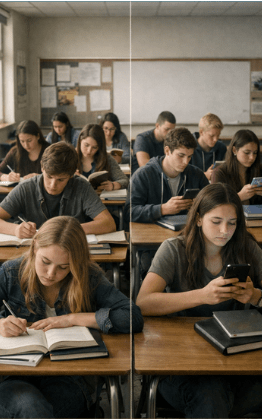
Usually, when we get pulled into one of these impromptu adventures, the kids sigh, resign themselves to being out for another 30 minutes, and pull out their phones.
It makes me ask myself: Is curiosity dead? It feels like we lost the desire to go out and discover the world. Probably because the world is now delivered to us in the palms of our hands. That Hawaiian Chicken joint I mentioned earlier, as soon as I pointed at it and told the family I’d like to try it someday, the kids already had the place called up on their phones, pricing checked, Yelp reviewed and judged.
“Pass,” my daughter said. “Online says the place down the road is better.”
In one click of a button, and one side swipe on the phone the sense of discovery, adventure, and mystery surrounding trying a new restaurant was left swiped away. That place was tried, judged and convicted, and we never set foot in the place. Curiosity, no matter what the outcome, was killed. My kids might have been right; it might have been overpriced, greasy, and not as good. Or it could have been great. Screw the online naysayers. But the act of going in blind and experiencing the discovery has been taken away.
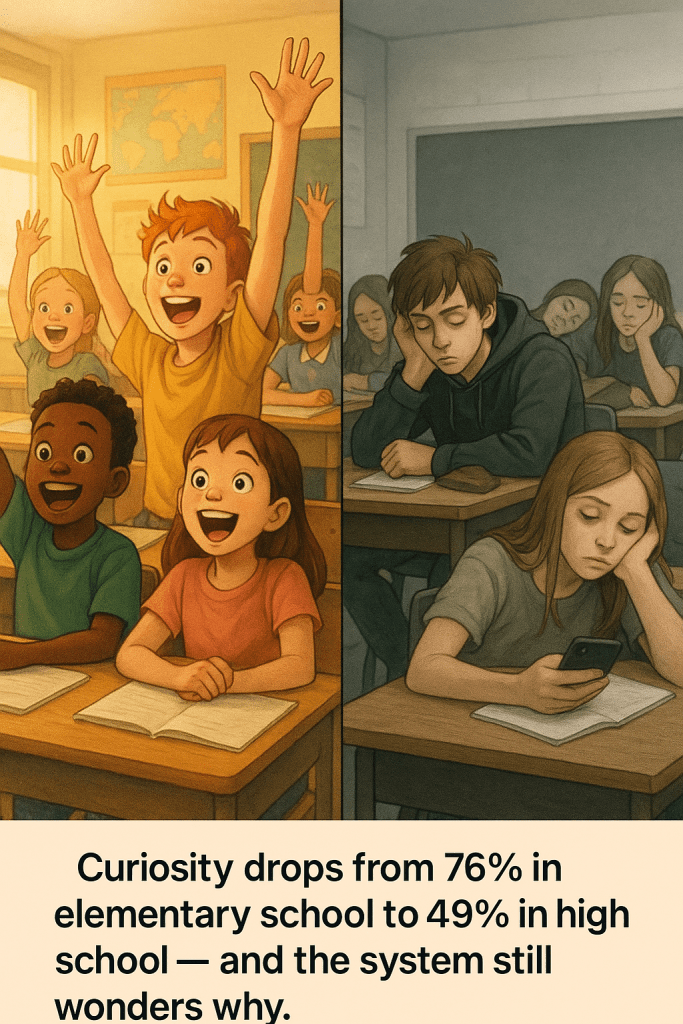
This isn’t just something I’m noticing with my own family. There’s data to back it up. As I compiled my notes for this post, I came across a very distressing statistic. Only 49% of high school students report feeling curious at school. (EdWeek Market Brief 2024) And that is a drop from 76% feeling curious in school in elementary grades. Between 25% and 54% of K–12 Gen Z students report they are not having “engaging experiences” at school. (Gallup 2024) This means what they are being taught doesn’t feel meaningful, interesting, or aligned with their talents.
Only 46% of high schoolers think their studies are relevant to the real world. (EdWeek/EdChoice) That’s a major problem. They are focused on what they have to learn, not building the skill of how to learn.
I get it, when we went to school, we often moaned, “Why do I need to learn this? I won’t use this in real life.” And sometimes we were right. I don’t use my knowledge of ancient Greek mythology while standing in the aisle at Home Depot trying to calculate how much lumber I’ll need. I don’t need it…at that moment. But what I was taught was how to learn. How to read, debate, think critically and deduce. How to explore new ideas. Curiosity. I learned how to figure it out.
But in 2001 there was a paradigm shift in the way our kids were educated. That paradigm shift was called No Child Left Behind. From that point on, schools and educational systems have been rewired to value performance metrics over actual learning. And that focus of metrics over discovery has killed intellectual curiosity. Before No Child Left Behind testing was a tool to track progress. After No Child Left Behind, testing became the point, the end game. Schools started teaching to the test, narrowing their curriculum (If it’s not on the test, it’s not taught), and adopting a mechanical one-right-answer (the one on the test) mindset. In essence, our kids are taught to regurgitate, not explore. Video killed the radio star. Teaching to the Test killed the curious child.
Under No Child Left Behind, teachers were evaluated by how many students hit a “proficient” score and if scores improved year over year. Stats were the goal. This created a culture of fear, pressure to perform, rule following, avoidance of anything that negatively affects test results. Kids learn that statistics and measurement are valued over curiosity and experimentation.

As a result, schools decreased instructional time in art, music, history, science, civics, and exploratory play. What is the result? A generation of science-hating anti-vaxxers who don’t understand their government, disregard truth, law, and the Constitution. Hmmmm…how did we get here?
And the Every Student Succeeds Act, which replaced No Child Left Behind, didn’t fix the problem. Testing companies became the gatekeepers to your child’s success. How much pressure is your child under to perform on the ACT and SAT? Parents see success as a number. Politicians post test scores to win votes. And the stats we’re seeing now, the crashing curiosity, the anxiety, the boredom, are the results of a system obsessed with stats and algorithms.
It must stop.
We can blame schools and politicians all day long, but curiosity doesn’t start in a classroom; it starts wherever a question hits, in the car, in the kitchen, in the garage, at the gym. And I can say with confidence, curiosity begins the second the headphones are pulled out. It starts in the quiet moments where akid thinks, “I wonder…” and someone lets that wonder live. Stephen King says in his book On Writing, his best ideas always began with “What if…”
Curiosity won’t come back when a district writes a curriculum.
It comes back when we stop outsourcing discovery to test results and start modeling what it looks like to be fascinated by the world again.
So maybe the fix isn’t a new law or another education reform bill.
Maybe the fix is simpler:
Turn down the noise.
Turn off the phones.
And go chase the damn searchlight.
Your kids won’t remember the test scores, but they’ll remember the adventure.


 DAD BOD WEEKLY