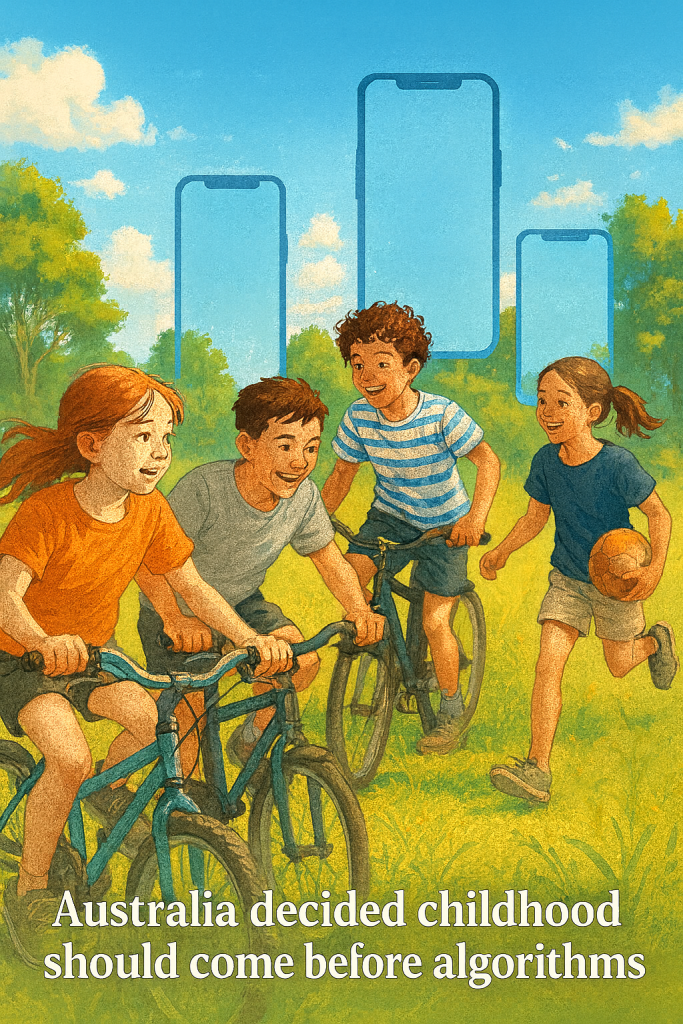
It sounds extreme. The data says it’s overdue. Australia just did what most parents secretly want but feel powerless to do. What looks radical might actually be the first real line of defense for kids’ mental health.
Last week, Australia may have changed the game in the battle for kids’ mental health and online safety. If you could see me right now, you’d see a middle-aged father standing at his desk giving Australia a standing ovation. Finally, there are politicians with an actual spine.
The news is simple. It’s actually BRAVE. Beginning December 10, 2025, social media platforms operating in Australia will be legally prohibited from allowing children under the age of 16 to create or hold accounts under the Online Safety Amendment (Social Media Minimum Age) Act 2024 (Time Magazine, 2025). No filtering. No “parental supervision” fig leaf. No “trust us” from Silicon Valley. Social media for minors is banned.
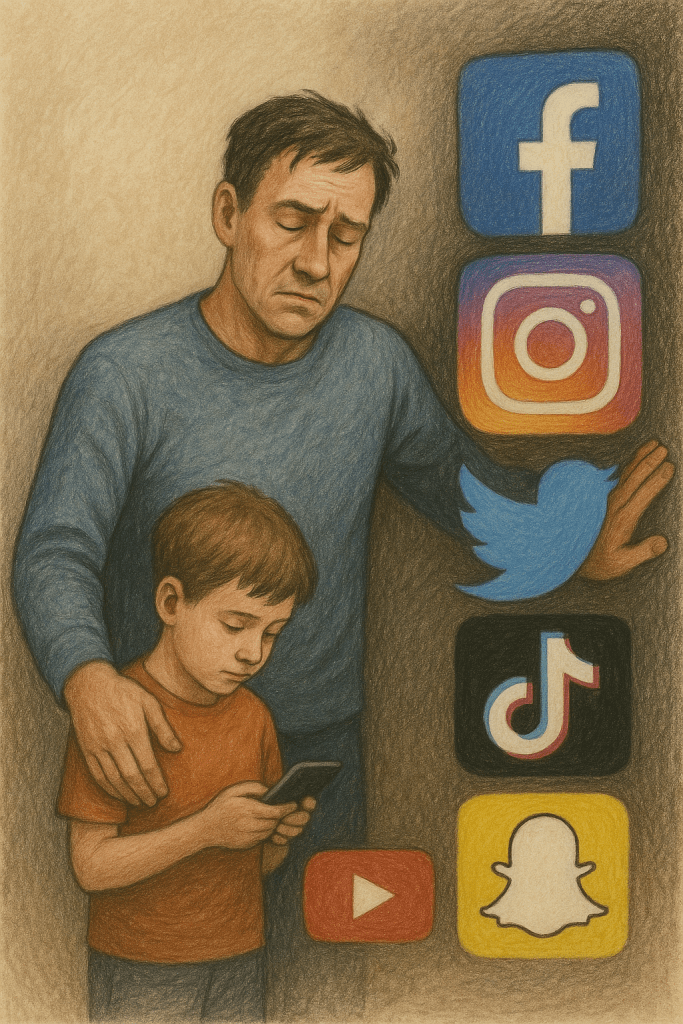
Under the new law, if you’re not 16, Facebook, Instagram, YouTube, TikTok, Snapchat, X (Twitter), Reddit, Threads, Twitch, and Kick will be off limits. Kids will still have access to WhatsApp, Messenger Kids, YouTube Kids, Google Classroom, Discord, Roblox, Pinterest, GitHub, and similar services designed for communication or learning rather than algorithmic addiction.
Why? Kids cry. Why?
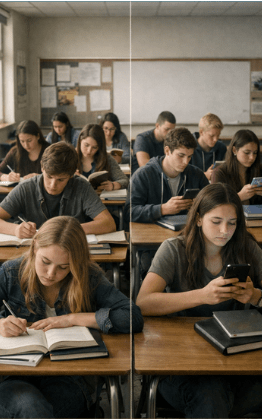
Because the data is in. Social Media is the worst thing that can ever happen to a gullible, defenseless horned up kid. Strip away the tech industry bull shit about “connection” and “bringing the world together” and we see the hard reality: kids are struggling, mentally, physically, socially and developmentally. Social media makes their problems worse.
In Australia, the majority of kids on social media between 8 and 17 have reported coming across some kind of harmful content, whether that’s harassment, dangerous online challenges, or unhealthy body image. (Australian eSafety Commissioner, 2023).
It’s no different with our kids, In the U.S., nearly every teen is online, while a third admit they’re glued to their feeds almost constantly. (Pew Research Center, 2023). For girls especially, spending just a few hours on social apps each day can push the risk of depression up drastically.(U.S. Surgeon General, 2023; Mayo Clinic, 2024).
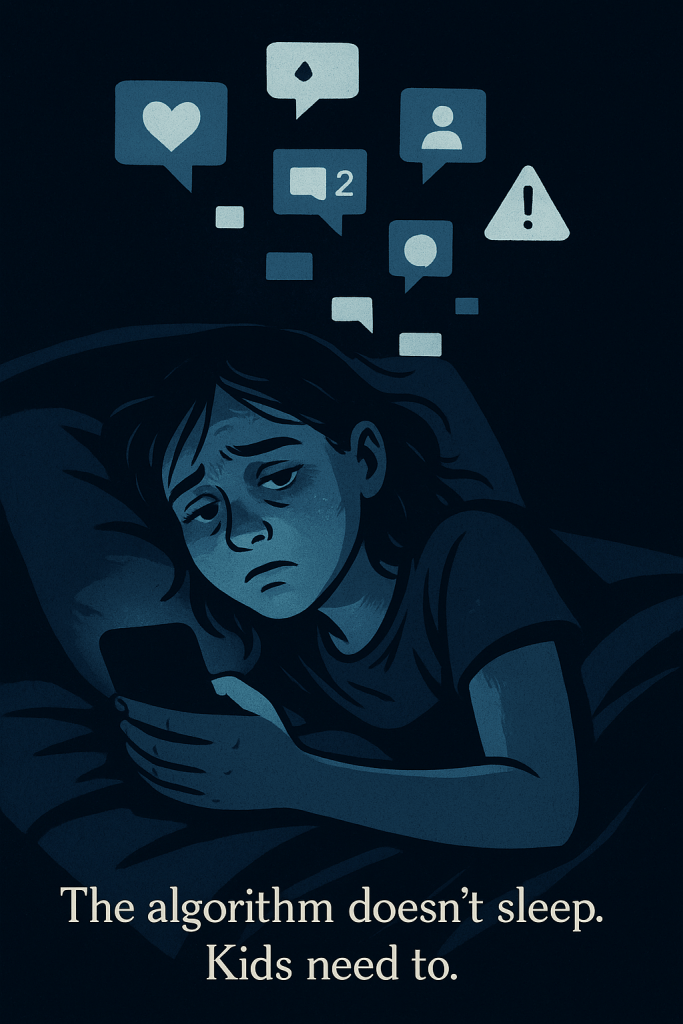
And it’s not just mental health collapsing. Kids are losing sleep. More than half of teens say social media keeps them up at night, even though they know it’s harming their ability to function the next day (Pew Research Center, 2023). Sleep deprivation alone is linked to increased depression, anxiety, and academic struggles.
Body image takes an early hit too. Research consistently shows that adolescent girls exposed to heavily filtered and appearance-focused content report higher levels of dissatisfaction with their looks by early adolescence (Ballard Brief, BYU, 2023). This dissatisfaction appears years earlier than it did in pre-social-media generations.
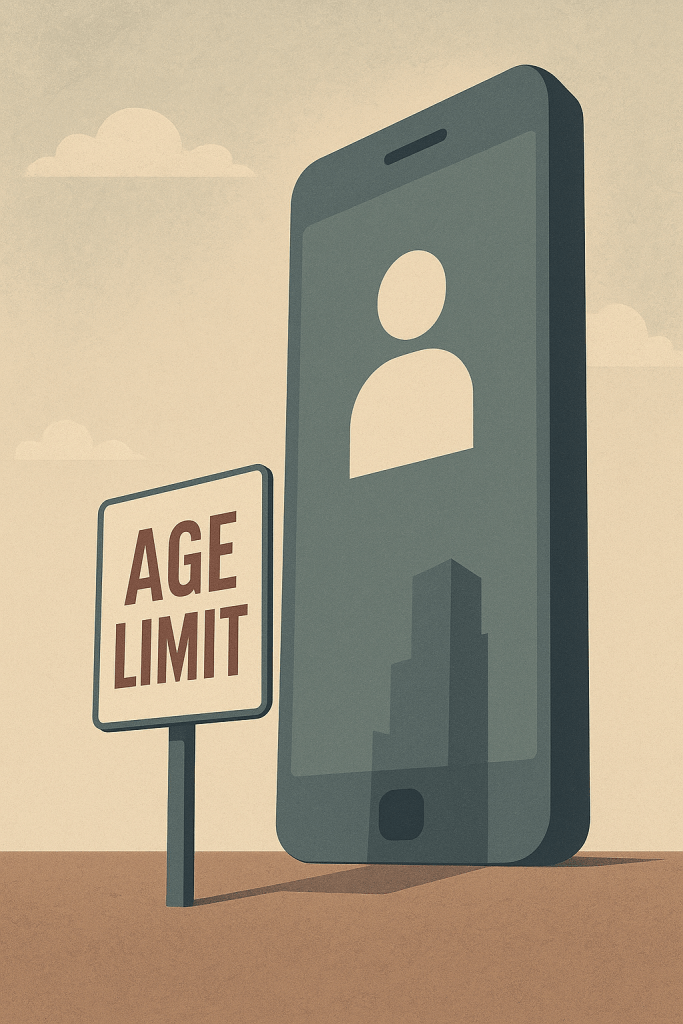
So what did Australia actually put in place? Under the Online Safety Amendment Act 2024, platforms are legally required to block or delete any account belonging to a child under that cut-off. If companies refuse to cooperate, they face massive fines, nearly fifty million Aussie dollars’ worth. (Associated Press, 2025)
If an account gets flagged by mistake, there’s an appeals process, but the new rule is “lock the account first, ask questions later.” This is the first ban of its kind on a national level anywhere in the world. In very Australian fashion, they politely but firmly told Silicon Valley to buzz off and actually put their kids first.
How did this ban start and get enough traction to become law? It started with Jonathan Haidt’s book “The Anxious Generation” (published March 2024). South Australian Premier Peter Malinauskas’ wife read the book and talked to him daily . “You better bloody do something about this,” she advocated. He commissioned a state-level draft law that spread to neighboring New South Wales, then went federal.
The response among constituents was very positive. 77% of Australians back the ban (YouGov, 2024).). Why? Haidt said cutting kids off from Social Media is freeing kids “from the social media trap”. The law protects children from cyberbullying, online predators, harmful content, and addictive algorithms. You’ve seen my rants against ROBLOX (Read it here), Male Loneliness (Read it here) and the unhealthy relationships developed online (Read it here). Getting kids off social media will force them to develop real-world- interactions and relationships. That’s a big step in kids mental, social and psychological well being. In addition, the law is backed by parents whose whose children died from online-related incidents.
In fairness there are some critics of the law. Only 9% of teens surveyed support it (ABC survey of 17,000 teens). That’s to be expected. Teens don’t want their online social lifeline cut. Critics say it Infringes on freedom of expression and access to information. But that’s where I disagree. We live in an age of deep fakes and fake news. Social media is no longer a credible place for gathering objective information. (You can read my rant against deep fake AI here). Critics are arguing the new law can be a privacy nightmare requiring biometric data/ID from all users. They also state the ban from social media cuts vulnerable kids (LGBTQ+, rural, marginalized) from support networks. 73% of young Australians accessing mental health support do so through social media. All of these are valid points. But it underlies the issue that there is a problem. This is a first step of many that need to happen.
But can this work in the United Sates? Half the country would riot, the other half would livestream it to TikTok. I firmly advocate having this discussion. And we need to have it at the congressional level. Finally, a law like this assist parents. A law like this is a little bit of relief in a battle against apps designed by the smartest addiction scientists in the world. The the social media companies, your child is nothing more than a product. A law like this is an early line of defense. It helps parents guard their kids childhood. It’s one small wall between your child and billionaires who have proven themselves unethical who profit off of your child’s endless scrolling dopamine addiction.
And then there’s the plain nostalgia: what if kids could have a real childhood again? What if they could be bored, or go outside, or hang out with actual friends instead of avatars optimized for dopamine hits? It’s a wild idea these days, but Australia wants to give their kids that space. Boredom is essential to kids development (read why here). (American Academy of Pediatrics).
We set minimum ages for all sorts of things, alcohol, driving, tattoos, because society agrees those privileges come with risks. No one gets outraged that ten-year-olds can’t drive a car, because we know they aren’t ready. Why not treat social media, which can be just as damaging to a developing brain, the same way?
Plus, for once, it’s the tech companies who have to do the work. After years of “Oops, our algorithm did something bad, want a new emoji?” the government is making them directly responsible for kids’ safety.
Of course, this isn’t the only solution. The problem is much more complex. Kids will try to get around age checks, no software is perfect, and there’s the danger that some will simply migrate to lesser-known, less regulated corners of the internet. Not every issue is going to disappear. But sometimes the best solution isn’t the perfect one. But it’s the first one. We must at least try.
Maybe this time, a radical idea is the right idea. Maybe we were wrong to let kids spend so many years believing their worth is measured by “likes.” It’s not about deleting apps. It’s about giving kids a decade of their life back, a chance at boredom, at friendship that is genuine, at confidence that isn’t algorithm-approved. A chance to have real hobbies, to read a book, to touch grass, to actually get a full night’s sleep.
So yeah, it seems crazy at first. I remember in the 70’s mandatory seatbelts were crazy. Child car seats were crazy. Bike helmets were crazy. Banning smoking in bars and restaurants was crazy. Outlawing drunk driving was crazy. Banning lawn darts was considered an infringement of our freedom. Sometimes, the thing that looks wild is really the beginning of something better.
As a result of this new law, six additional countries and considering similar laws. Denmark is planning a ban at age 15. Malaysia is proposing a similar Australian style law. New Zealand is proposing an under 16 ban. The EU Parliament voted for non-binding resolution on aa minimum age.
Jonathan Haidt (psychologist, author of “The Anxious Generation”), the man whose book started this idea called social media “the largest corporate destruction of human potential in human history”. And he’s right.
Australia decided kids deserve another shot at a real childhood. Maybe it’s time we did, too.

 DAD BOD WEEKLY