The Class Divide of the Future Will Be Defined By Who Can Think and Who Can’t. Your Kid’s Ability to Think Clearly Will Matter More Than Grades, College, or AI.
Why critical thinking, not test scores, not college prestige, not AI fluency, will determine which kids rise and which are left behind.
#
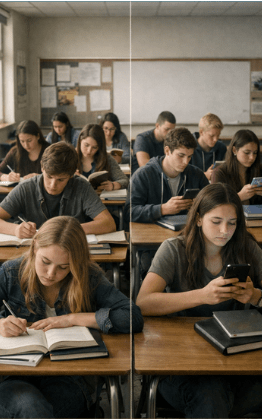
A quiet crisis involving our kids and their future is unfolding in real time. It’s happening so subtly that we as parents have no idea it’s happening. Our teachers are sounding the alarm bells, but we are ignoring them.
We all know there’s an economic divide happening in this country. The term economic divide is too kind. We are on the verge of an economic Grand Canyon-sized chasm that will separate the haves and the have nots. But the surprising part is that this divide will not be determined by who gets in the best colleges, has the highest degrees. Even Ivy League college kids are affected. Over 40% of Ivy League college students are claiming to have some sort of learning disability. This allows them to have extra time to complete assignments and take tests. Either they are gaming the system, or even the highest-performing college students are struggling with basic comprehension and critical thinking skills.
The best and latest AI tools can’t help our kids here. The economic class system and dividing line will be drawn by those who can think clearly and who cannot. And right now, we’re raising a generation that’s struggling with both.
Teachers across the country are reporting a disturbing phenomenon that transcends economic status, school system, race, sex and home stability. Our students can see words but can’t comprehend their meaning. In other words, they can easily pass a multiple-choice test. They can be taught to pass that style of test. But students are consistently failing when asked to synthesize information and draw logical conclusions. They may know how to read, but they don’t understand what they read. Why? Any AI chat program can summarize an article for them. Any term paper is a simple cut and paste job with an extra step of running it through some AI detection filters.
Students are struggling to master the process of digesting information, thinking about the information, and formulating their own conclusions about the information. Our kids are stuck in the summary of information. They’re not even getting to the digestion of information phase.
And that exposes a big problem for our kid’s future. If our kids can’t grasp basic comprehension skills, they are unemployable.
As a parent, I worry about the same things you probably do. Will they get good grades? Are they taking enough AP classes? Will they get into a good school? Will they have a good career? Is my son using protection? Who is this guy named “Dirty Dan” that keeps texting my daughter? Are my kids able to keep up with the newest technology to make them competitive in the future job market?
But I admit, focusing on these worries is focusing on the wrong problems. The real problem is that A.I. and any shiny new technology won’t help any kids that don’t learn how to reason. A.I. won’t save them. It will widen the gap between them, the haves and have nots.
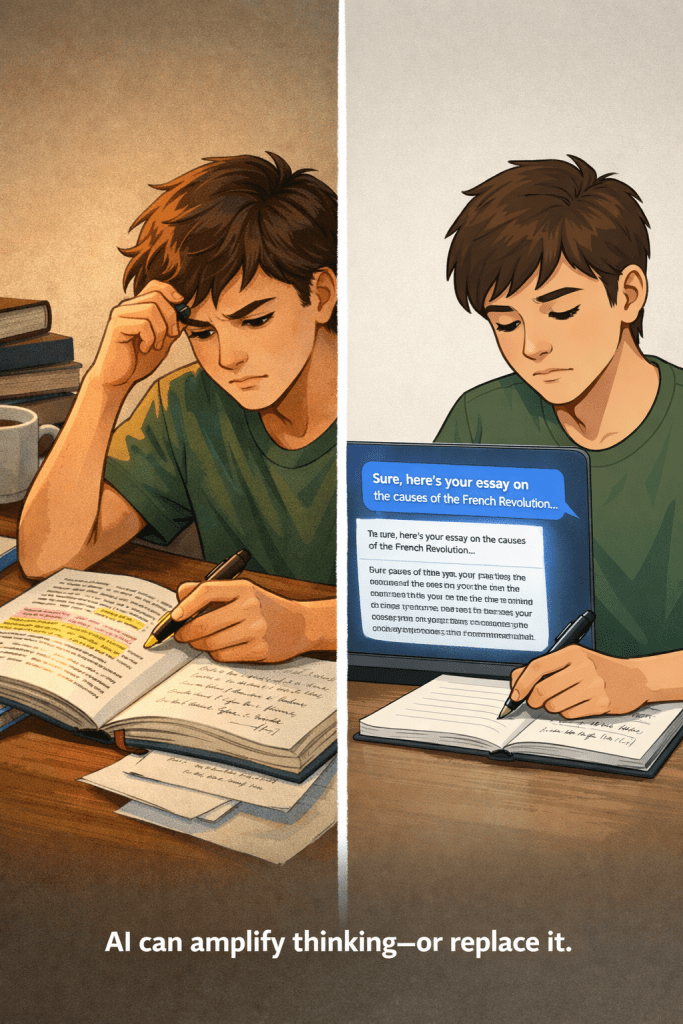
A student who learns to think critically will be able to use AI as a power tool. It can be something that can save them time, multitask, or coach a new capability. A student who can’t, will use it as a cut and paste shortcut. Sure, they’ll turn the assignment in. But it will be a superficial rehash of all the other superficial rehashes the AI tool has been trained to barf out. Unoriginal thinking gets you nowhere in tomorrow’s job market.
The job market won’t care if you can prompt an AI to write a cover letter. It will care whether you can understand your boss’s instructions, analyze a problem, and communicate a coherent solution.
The decline of critical thinking and problem solving in our schools isn’t a slow subtle slide. We’re going over the cliff. Teachers across the nation are sounding alarm bells. Our current crop of students can’t follow multi-step directions. They struggle to distinguish between the main ideas and supporting details. They can’t make basic inferences from text. They cannot construct logical arguments. They lack vocabulary to discuss complex ideas. These are not advanced academic skills.
I’ve previously written about the drawbacks of social promotions. Here the consequences play a part again. Social promotion policies mean many of these students have been passed along for years without anyone addressing the problem. They’ve been told they’re doing fine. Their grades don’t reflect their actual capabilities. Their transcripts look acceptable. Then they hit the wall of genuine complexity, advanced coursework, college material, or entry-level jobs, and discover they’re not prepared.
Aldus Huxley’s Brave New World warned us about the onset of complacency, easy pleasure replacing difficult tasks and the dumbing down of society to maintain control. We need to realize that Huxley was right. The Brave New World is Here.

The great divide of the future won’t be defined by income inequality or zip codes. Those will be the end results. The new class system will be cognitive. The critical thinkers, problem solvers, and aggressive learners will adapt and rise to the upper ranks of society. They will solve the problems and control the direction of society. Andy they will be well paid for doing so. Those who can’t grasp these skills will be relegated to menial task work. Have you heard of the term “Gig Economy”? An entire class of worker is being created that handles the menial tasks the problem solvers have de-prioritized. In a decade we will have an entire workforce of underemployed, underpaid, unchallenged errand running workers.
The new upper class will be those who can stick with and read complex material, reason through problems, and communicate direction clearly. They’ll adapt to whatever technology comes next. They have fundamental mental tools to learn anything. They’ll always have a job because they can reason, develop, and execute.
The new underclass will be kids that shuffled through the system without developing any core competencies. We hear the term “weaponized incompetence.” It’s a way of refusing to learn and getting others to accept a lowering of the bar. 40% of our elite college students are using weaponized incompetence to claim learning disabilities and getting excused on tests and deadlines. And we accept blaming teachers when students learn the power of weaponized incompetence.
The result? They’ll struggle to hold jobs that require anything beyond following simple scripts. They’ll be the first replaced by automation because their work doesn’t require the one thing machines still can’t replicate: genuine reasoning.

So how do we stop the divide from advancing?
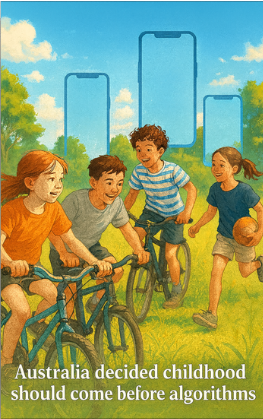
First is to take away the phones and screens. Many schools across the nation are banning phones, laptops, and pads in the classroom. And they are right. These are tools to process tasks. But in the class, they’ve become crutches that are doing the work and providing the shortcuts. A.I. is doing the summarizing instead of the student reading. Cut and paste has replaced cursive. Screens have shortened kids’ attention spans to the point where sustained reading feels impossible. Why struggle through a difficult paragraph when you can watch a 30-second TikTok summary?
Waldorf Schools in Los Altos California bans screens in all classrooms through 8th grade. The Waldorf School of the Peninsula student body is comprised of children of tech executives from Google, Apple, eBay, Yahoo and HP. Even the tech execs know too much screen time lowers critical thinking skills.
Eaton College in the UK has banned all smartphones for incoming students. Britain’s future leaders are learning phone free.
Second, we must ban the concept of social promotion in our schools. Social promotion means students advance regardless of mastery. Schools are incentivized to move kids along, not to ensure they can think.
Third, we must ban teaching to test. The No Child Left Behind Act and Every Kid Succeeds Act have failed. They have replaced actual learning with getting by to just passing. We’ve optimized standardized test scores at the expense of actual comprehension.
Fourth, let’s no longer accept learned helplessness and weaponized incompetence. When something is hard, kids don’t struggle through it; they ask ChatGPT for a summary or give up.
If your teenager can’t comfortably read and understand a college-level article, they’re in trouble. Real trouble.
The jobs that don’t require critical thinking are disappearing. The ones that remain will be low-paid and precarious. The good jobs, the stable, well-compensated ones, will all require the ability to process complex information and make sound judgments.
Your kid’s ability to reason clearly will determine their economic class more than any other single factor. Not their connections. Not their degree. Not their ability to use the latest tech. Their ability to think.
We’re at a turning point in modern education for our children. The kids who can develop strong reasoning skills will survive. The kids who don’t, will struggle in an ever-changing economy, society, and class system.
And that divide is being created right now, in our homes and schools, with the choices we’re making, or failing to make, every single day.
It’s our move.



 DAD BOD WEEKLY