

Traditional Catholic and Evangelical movements are offering young men certainty, hierarchy, and rigid gender roles. But are they finding faith, or just hiding from a changing world?

There’s a new trend developing among Gen Z men (age 13 – 28) and their religious affiliation. In the coming year, this trend is poised to reshape the religious landscape (and potentially the political and social landscapes) of the country and your family for the next generation. Gen Z men are slowly gravitating away from modern church services and mega congregations and towards more traditional conservative denominations and congregations.
The numbers are not suggesting a mass revival…yet. But it’s enough to notice and identify the early signs of a coming trend. Let’s look at some of the numbers. For the first time in 25 years, men are outpacing women in regular church attendance. Roughly 43% of men report weekly attendance compared to 36% of women (ReligionNews.com). The Barna Group report states that between 2019 and 2025 the number of men reporting a personal commitment to Jesus rose by 15%. Young Catholics (ages 18–29) are now reported to be the most engaged demographic within the Church, attending Mass and Confession at higher rates than Gen X or Boomers (America Magazine).
So where are they going? These young men are gravitating toward Traditional Latin Mass (TLM) in Catholicism or Reformed (Calvinist) theology in Evangelicalism. This means these young men are choosing high-structure, high-demand forms of religion that offer clear authority, thick tradition, moral boundaries, and a coherent worldview. This is usually a reaction to a culture they perceive as unstable, unpredictable and difficult to navigate. In these conservative churches, there is clear authority and hierarchy. And they are unquestioned and unchallenged. God—Church—Priest—Laity. The structure is unbending order, and it is not discussed in a support group.
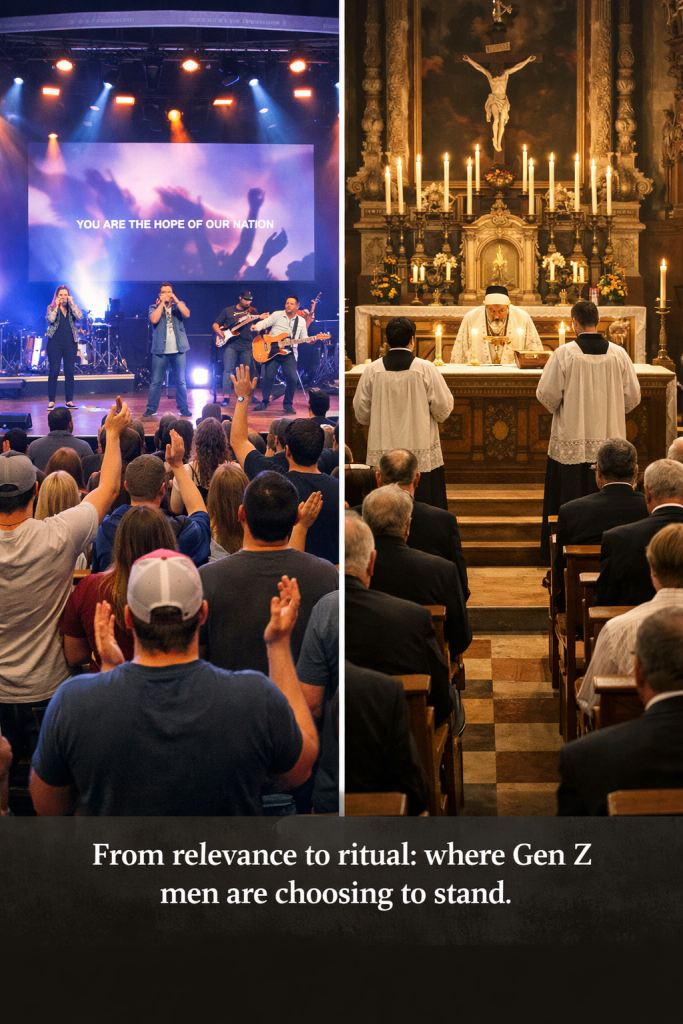
In traditional denominations, morality is clearly defined and unquestioned. Sin exists and it exists in black and white. There is good and evil.
Gender roles, marriage structures, and moral boundaries are clearly defined, man and wife, two genders, marriage for life, with the man as provider and the woman provided for. Prayer, silence, chant, ritual. Nothing is explained. Nothing is optimized. You submit to it before you understand it. There are clear moral expectations. Church is an authority. Church is accountability. Humans are fallen. Grace is earned. Your job is obedience to the word, not self-expression.
The gray areas that exist in modern evolving society are conspicuously absent from these traditional denominations. In a modern society we continually wrestle with the concepts of family, gender roles, sexuality, homosexuality, transgender visibility and acceptance, masculinity, women empowerment. Vanity Fair’s recent cover story asks, “Do Women really need a boyfriend?” and challenges the male role in society. Traditional churches reinforce male dominance in home and society. In traditional churches, the woman defers to the man in all decision making. In a modern, ever-changing world, everything feels provisional. But the church authority feels stabilizing.
Young men feel in modern society that masculinity is always suspect. The truth is subjective (alternative facts, fake news), rules are negotiable (one gender, two genders, gay, straight, bi, political ambiguity, social norms changing) and commitment is optional (who needs a boyfriend?).
But in conservative denominations, these issues are swept away. The church tells the truth; roles exist; limits are real and accountable, and commitment is valued. Traditional faiths often provide a very specific blueprint for family and gender roles. The man is the provider, the protector, the leader. The woman should always defer to the man. In a modern society in which women are becoming leaders, higher earners and more independent, masculinity is feeling challenged and critiqued. Traditional religious spaces are safe spaces where traditional masculinity is celebrated and encouraged. The roles are clear here. Outside the traditional religious community, the roles are changing. And that is repackaged as “society is crumbling.” In here is safe, out there is evil. In here the patriarchal man and traditional wife are honored. Out there the single successful woman is part of the feminist movement that is killing the country.

The path of faith has become a quest to find certainty and order in what these men perceive to be chaotic end times. Young men are choosing the perceived certainty established by conservative denominations vs. the taxing and often confusing task of inquiry of their faith. In the struggle of certainty vs. inquiry, certainty is the safest route.
In high-structure congregations there is a clear definition of “right and wrong” usually defined by the church’s ruling authority (The Pope, the College of Cardinals, etc.). It’s easier to have the complex issues of a modern society boiled down to a binary choice (“It’s right or wrong”). And it’s easier to make that choice when surrounded by a community of like-minded individuals affirming your beliefs and all buying into the dogma established by the ruling body.
This contrasts other traditions such as Presbyterianism, where questioning and debate are not seen as signs of weakness, but as the primary way faith is continually refined. But young men are rejecting that fluidity. In a world filled with social anxiety, changing norms and social and economic changes, the unchanging traditional belief system of a conservative denomination is a safe space sanctuary.
The structure, not faith, is the draw.
In addition, loneliness is at an all-time high for Gen Z men. And this lays directly at the feet of social media. Our young men are not learning how to develop real world communication and social skills. Scott Galloway’s book offers the statistic 43% of high school boys have never asked a girl out on a date. The swipe right and swipe left culture has killed all sense of human connection in our children.
Traditional denominations remove the necessary communications needed between man and wife. It is clear, the man is the leader. The woman defers to the man. Discussion ended. This is safe and certain for young men. Traditional denominations are safe places where young men and women have clearly defined roles and expectations. The stricter roles and definitions remove conflict found ins secular society.
While I have no problem with an individual choosing a religious denomination that is more conservative, I do see distinct problems with this emerging trend.
First, these young men and women are not equipping themselves to deal with the real world, a world that always changes. From the day man crawled down out of the trees and into the caves, the world has always been changing.
It always has and always will.
Life changes, and it’s not something we should run away from. Issues of what defines a family, what are our roles in society, equal rights, equal pay, independence, inclusion, and acceptance have always been topics of discussion regardless of which generation you belong. I fear joining these traditional churches sets up an “us vs them” mentality. We the members of this community are righteous and have God on our side. You, the changing society, are the sinners and evil doers. This is the first step of very dangerous divisive thinking. And it is spilling into our modern-day society’s discourse. Check out any twitter feed filled with rally calls that “We are a Christian Nation!” while simultaneously calling for the Muslim Mayor of New York’s death.
Second, every time I read about this trend, faith never becomes one of the decision factors. This trend appears to address social anxieties rather than represent genuine theological discovery. The research I’ve encountered focuses on structure, certainty, and traditional gender roles, but rarely mentions Scripture, prayer life, or a deepening relationship with God. Young men aren’t describing moments of spiritual awakening or theological conviction. They’re describing relief from confusion.
They’re not saying, “I found the truth,” they’re saying “I found clarity.” And while clarity can be valuable, it’s not the same as faith. These conversions seem less about encountering the divine and more about finding a rulebook that makes navigating modern life easier. That’s not a spiritual journey, it’s outsourcing decision-making to an institution.
Third, where is empathy in this conversion? If young men and women are turning to traditional denominations to avoid tough social issues, aren’t they turning their back on those that need help? Are they sitting out the fight? Doesn’t the bible tell us to be involved with the issues of our modern-day society?
Romans 12:15: “Rejoice with those who rejoice; weep with those who weep.”
1 Peter 3:8: “Finally, all of you, be like-minded, be sympathetic, love one another, be compassionate and humble.”
Galatians 6:2: “Carry each other’s burdens, and in this way, you will fulfill the law of Christ.”
Quite simply, if a church denomination is filled with people that only want to avoid the issues of the society they live in, isn’t it just a homogenous echo chamber? Doesn’t diversity bring discussion? Doesn’t discussion bring challenges? Doesn’t challenge bring clarity? It truly feels like the ostrich sticking his head in the sand.
Lastly, where is the sense of service? When I researched this subject, I found many quotes from young people looking for community, clarity, like minded thinking, like minded belief systems. It’s a search for inward fulfilment. And there is nothing wrong with that. But something that is at the very core of any belief system is missing.
Service.
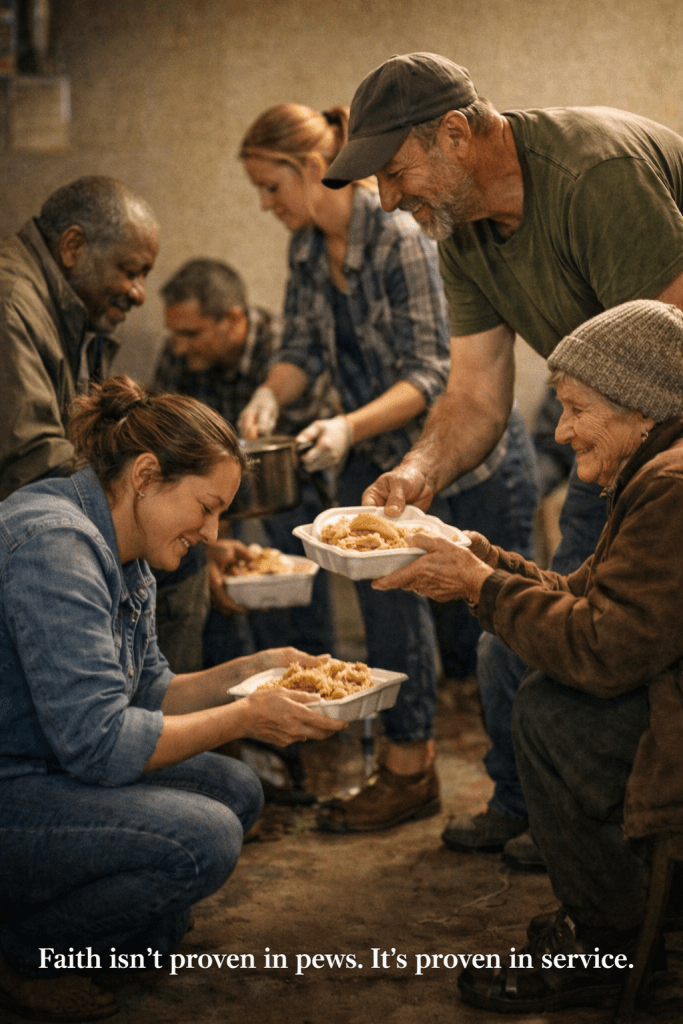
I get the sense that young men and women joining the traditional denominations are the people looking to be served. And that’s fine… to a point. There’s a difference between being served and being told what you want to hear. I fear the second is happening here. Traditional churches are telling these young converts what they want to hear: society is difficult, ever changing and unpredictable. Fine. But it’s wrong to frame that difficulty, change and unpredictability as a sign of sin and the end times.
That’s just fear mongering.
The Bible doesn’t just suggest that believers help others; it demands it. Acts are an essential proof of faith and a direct command from God. In both the Old and New Testaments, the “community” includes not only fellow believers but also the poor, the stranger, and the vulnerable. Service is difficult.
Matthew 20:26–28: “…instead, whoever wants to become great among you must be your servant… just as the Son of Man did not come to be served, but to serve.”
John 13:14–15: “Now that I, your Lord and Teacher, have washed your feet; you also ought to wash one another’s feet. I have set you an example that you should do as I have done for you.”
1 John 3:17–18: “If anyone has material possessions and sees a brother or sister in need but has no pity on them, how can the love of God be in that person? Dear children, let us not love with words or speech but with actions and in truth.”
Matthew 25:40: “The King will reply, ‘Truly I tell you, whatever you did for one of the least of these brothers and sisters of mine, you did for me.’”
If any young man or woman explores joining a conservative traditional denomination, it is imperative they investigate that denomination’s infrastructure of service to their local and world community. And let’s be clear; that service does not mean evangelism and conversion of like minded thinkers.
It means true service.
True service means giving something and expecting nothing in return. Faith is not transactional. If any denomination is not serving their community (believers and non-believers equally), that denomination is nothing more than a sterilized echo chamber. And that’s where the damage is done.
When a denomination is united against the discussion, discovery, discernment and growth of any social issue (gender roles, sexual rights, inclusion, service, human rights and decency) they are making the choice to ignore the written word of God to satisfy their own insecurities.
The Bible acknowledges that living a life of faith within a secular or “worldly” society is naturally filled with friction. But is avoiding that friction is avoiding God’s will? Doesn’t God want us in the trenches?
The question facing this generation is not whether traditional denominations offer structure and certainty; they clearly do. The question is whether that certainty comes at the cost of Christ’s example. Jesus didn’t retreat from the complexity of Roman-occupied Judea; He waded into it. He didn’t surround Himself with the like-minded; He broke bread with tax collectors and sinners. He didn’t offer His disciples a sanctuary from the world’s difficulties; He sent them into it with a mandate to serve, love, and bear witness. Young men and women seeking faith should ask themselves: Am I looking for a fortress to hide in, or a foundation to build upon? True faith doesn’t shield us from the world’s challenges; it equips us to meet them with grace, empathy, and service. The church should be a launching pad, not a bunker. And any denomination that promises otherwise may be offering comfort, but it isn’t offering Christianity.




 DAD BOD WEEKLY