The Reading Crisis No One’s Talking About: Only 11% of Teens Read for Fun
There is a reading and critical thinking crisis happening with our sons and daughters.
“Not my child!” I hear you pushing back. But it’s true. Our kids are struggling with reading long-form, thought provoking, intellectually challenging works. If they are reading a class assignment, programs like Chat GPT, Gemini and Claude can easily summarize it for them. But A.I. programs don’t challenge our kids to think for themselves. They don’t encourage them develop their own opinions or give them the confidence to defend their arguments.
And that’s dangerous. Why? The world our kids inherit won’t be divided by left and right. It’ll be divided by thinkers and followers. As the Tik Tok trend puts it, the Lions and the Sheep. Algorithms and A.I. programs can only summarize. They don’t teach dissent, they don’t teach contrarian thought, development of personal values, taking a stand, empathy or morality. Algorithms are only teaching reaction and calling it engagement. But it’s not true intellectual engagement framed in exploration and debate.
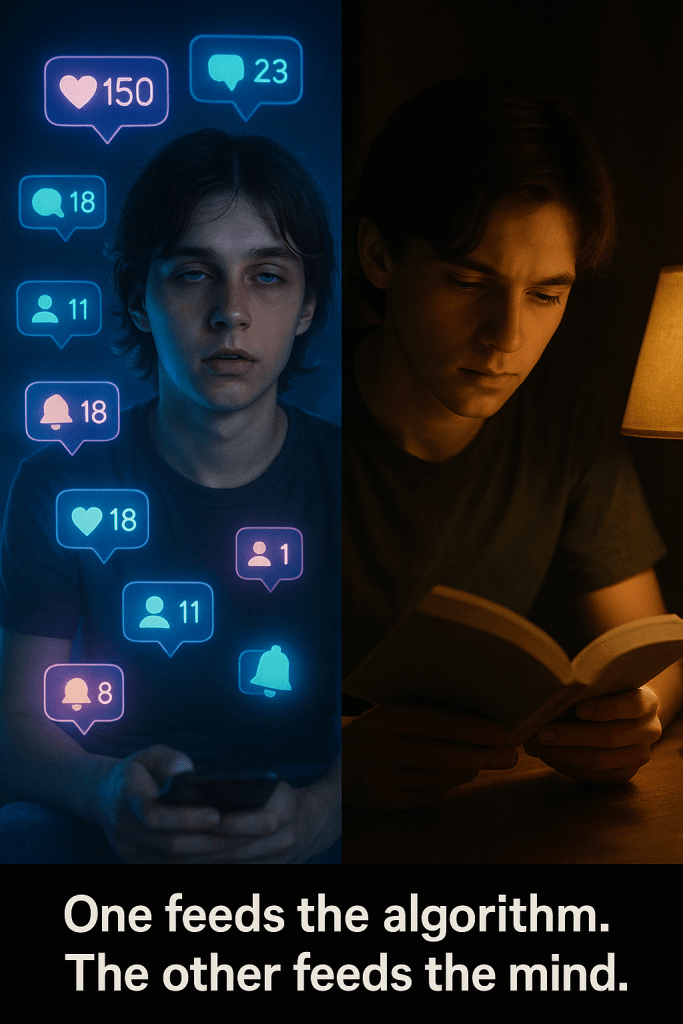
Social media algorithms mainly reward rage bait, click bait, shock, deception, outrage, envy, and fear. This is the brain rotting emotional fast food hurting our kids.
Long-form challenging written works like Brave New World, A Catcher in the Rye, It Can’t Happen Here, and Fahrenheit 451 force the reader to slow down, think, question and argue with what they just read. It requires a slow digestion of the subject matter. These works force patience, understand nuance, develop feelings and, in that solitary time with the book, develop their own manifesto for their life.
When our children (and us adults too) are confronted with an opposing, new or uncomfortable opinion or point of view, they (we) instantly go in to fight or flight mode.
Flight Mode
Let’s Talk Flight Mode First. Why? Because is it’s the easy route. When confronted with a challenging piece of written work, our kids are still bombarded and distracted by text messages, Snap Chats, Tik Tok trends and any other forms of social media offering the comforting and addiction affirming dopamine hit. When they are confronted with a challenging piece of written work it’s easy to put down the book, pick up the phone and get a soothing Tik Tok dopamine hit or find a piece of social media that agrees with them and tells them everything is ok. Agreeable social media is the destination of the flight. The always-on safe space.
But that’s the problem, instead of pushing though, wrestling with the text and going through that mental wrestling match of developing their own opinion and conviction, they turn away to what’s easier. The practice of a critical life skill, building confidence in your own Point of View, is killed on the vine before it can bloom. If they can’t learn to defend their opinion now, how will they do it when they are out on their own? Then they become easy targets for the grifters, charlatans and con men they will surely meet as adults.
Fight Mode
When kids are confronted with ideas they don’t understand in a challenging piece of work, they first shut down. Then they fight back.
First, they’ll blame the work.
“The Catcher in the Rye, Brave New World and The Great Gatsby are old works that don’t relate to me. Why do I have to read this old crap? It has nothing to do with my life today.”
Not true, stories with themes of empathy, curiosity and civic apathy have everything to do with what kids are going through today. If they don’t like those books, they can switch to The Circle (Eggers), Eleanor Oliphant is Completely Fine (Honeyman) or A People’s History of the United States (Zinn) for similar discussions.
Second, they’ll blame the teacher.
“I’d understand this book if the teacher did a better job of explaining it to me. He’s such a bad teacher.”
It’s perfectly ok if our kids struggle to understand the themes discussed in these long formworks. Why the hell is Holden Caulfield asking always asking about the ducks? These books are meant to be challenging. The danger is when our kids quit and not even engage in the conversation. It’s a terrible life habit that becomes nearly impossible to break.
Third, They’ll get mom and dad to blame the school and school system.
“Why do they have to learn this stuff? It doesn’t provide any life skill!” How many times in the past decade have we seen attempts to ban, 1984, Brave New World, Catcher in the Rye, Fahrenheit 451, Lord of the Flies, Animal Farm, and It Can’t Happen Here. We’ve turned away from the healthy discussion of ideas to the dangerous expulsion of ideas. “Our schools are failing us! They’re indoctrinating our kids! They’re pushing their agenda on me.” We’ve dropped the banner of personal discovery and growth and picked up the banner of blame.
It’s time to demand SSR, Silent Sustained Reading Time
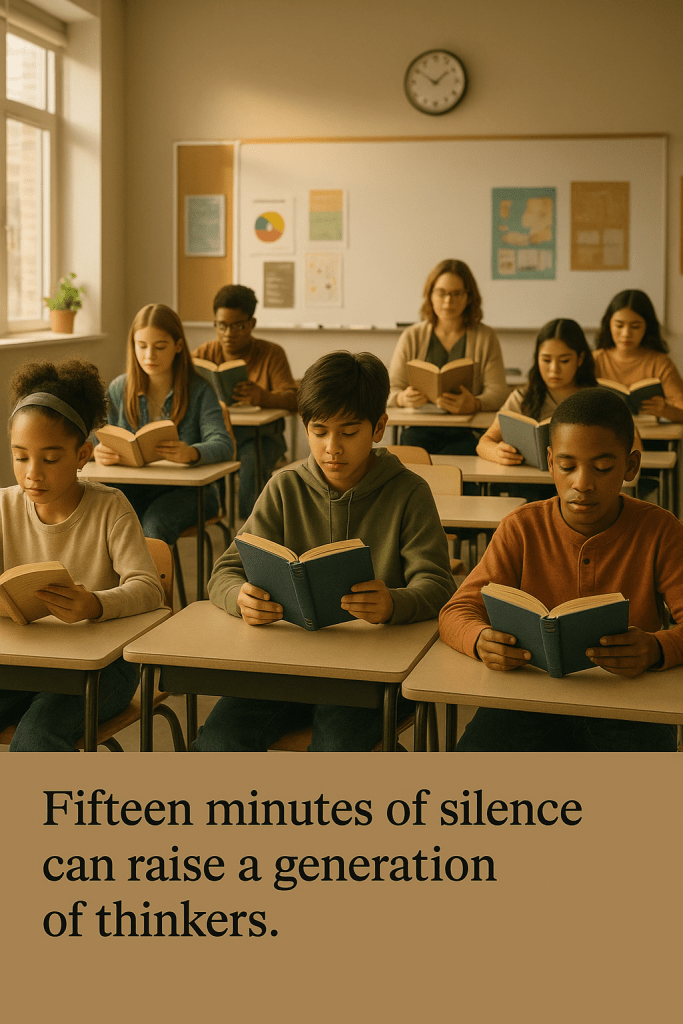
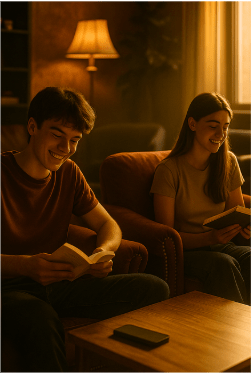
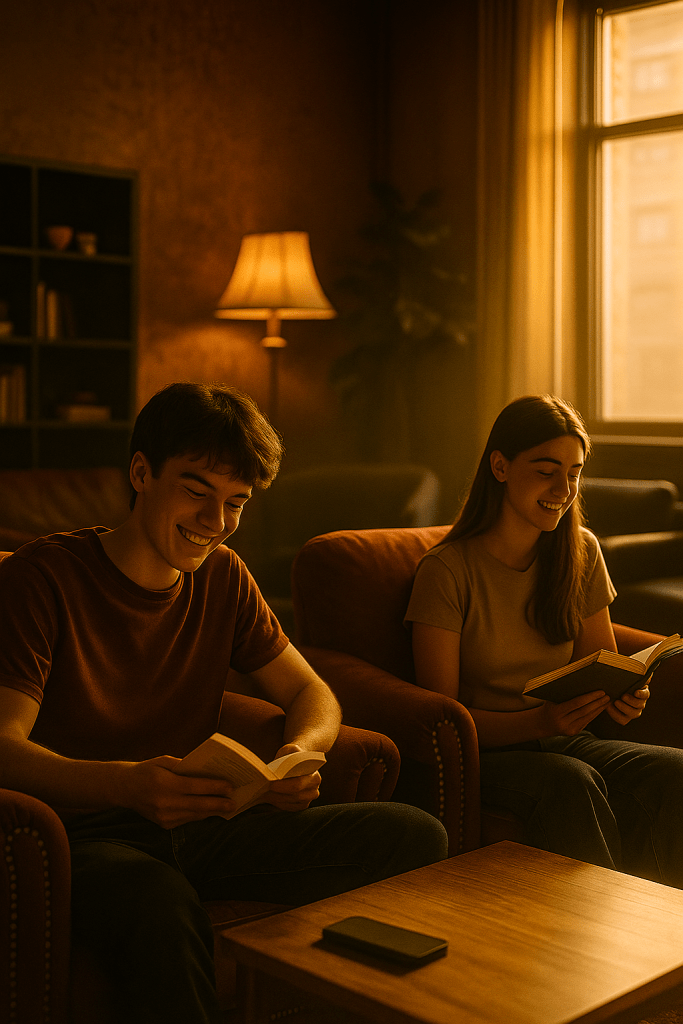
Many schools still institute a period of the day for Silent Sustained Reading time. A time where kids can just sit and read. Anything they want, from challenging works to entertaining low brow comedies. Just read.
Reading for pleasure and/or self-education is rapidly declining the U.S. This is the reading a student does simply for joy of reading, entertainment or intellectual curiosity, anything outside of required school reading. And this decline is becoming a big problem. In 1976 40% of high school seniors reported reading at least six books for fun in the previous 12 months. By 2022 that number has dropped to 11.5%.
A U.S. study of 12th graders (high school seniors) reported that in 2019 about 26% said they never read stories or novels outside school.
Reading outside of school not a luxury. It is essential for human development. It develops intellectual curiosity, empathy, independence, and a world view consciousness. Voluntary reading builds confident independent thinkers.
It builds freedom of thought and the free exchange of ideas
Independent reading exposes kids to new voices, authors, thinkers. In a time of polarization and algorithmic echo chambers, free reading may be one of the few remaining tools that encourages genuine intellectual diversity.
It builds a sense of empathy by exposing them to new points of view.
Walking in a character’s shoes teaches empathy far more effectively than lectures about tolerance.
“You never really understand a person until you consider things from his point of view… until you climb into his skin and walk around in it,” Atticus Finch tells Scout in To Kill a Mockingbird.
Starr Carter’s dual existence in The Hate U Give, between her black neighborhood and a mostly white prep school, puts readers inside the lived experience of code-switching and racial injustice.
It builds intellectual curiosity and life long learning.
The habit of asking “why are things this way” beyond the school test is the most valuable skill our kids can learn.
It builds a sense of Identity and helps them find their own voice.
The teen years are an angst ridden quest for identity; independent reading offers models, mirrors, and mentors. It helps them find their heroes and villains. Discovering a character, idea, or writer who “gets” them often provides the courage to think and speak authentically. The classroom asks for analysis; personal reading invites resonance, the moment a student realizes “this is who I am” or “this is who I could be.”
If we want to raise thinkers (Lions), let’s encourage Silent Sustained Reading time. Demand it at school. Or implement it at home. Model it with your kids. Survivor can wait. Let them discover books that entertain them, scare them, piss them off, or make them question everything, including you. Then let’s be available to talk about it. Debate it. Laugh about it. Let’s get engaged, away from the phone.
I remember the first time I read 1984 and realized the adults were lying. That moment hurt, and it woke me up. Every generation needs its own awakening. Ours came through books.
If we don’t give our kids that same awakening, someone else will. It won’t come from Orwell or Huxley, it’ll come from the algorithm, feeding them exactly what keeps them quiet.
So let’s bring back Silent Sustained Reading. At home. At school. Anywhere we can carve out time of stillness. Let them read something that confuses them, enrages them, or changes them.
That’s how independent thinkers are made.




 DAD BOD WEEKLY