
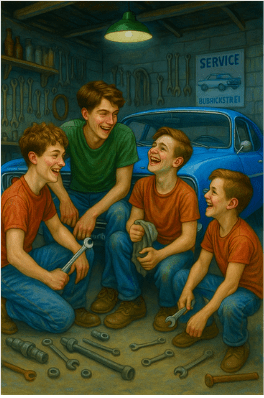
connecting in a garage surrounded by car parts and tools.

Social isolation among young men is rising fast. The fix isn’t another app, it’s giving boys back the time and places where they can just be kids.

There’s an epidemic affecting our sons. And it is just as dangerous as any physical, mental, digital or chemical threat they face growing up. It’s called the “male loneliness epidemic”. Among young men, specifically those in their teens to early thirties, social isolation and feelings of loneliness are rapidly on the rise. In one State of American Men Survey (Equimundo 2023), the majority of men surveyed agreed with the statement “No one really knows me at all.” In the US Surgeon General 2023 report, Surgeon General Vivek Murthy warned the public about “our epidemic of loneliness and isolation” framing it as a public health crisis.

How is this manifesting in our kids? 45% of boys aged 18 – 24 have never asked a girl out on a date in person. I get it. It’s always been difficult for a boy to muster the courage to ask a girl out. It makes them extremely vulnerable. And in today’s digital world, asking a girl out (and her saying no) runs the risk of becoming a very public and very embarrassing meme to be passed around and taunted. I’ve written about our kids becoming socially risk averse in my post Why Our Kids Don’t Trust Anyone Anymore (Thanks to the 24/7 Camera) (Click to read).

So what’s contributing to this loneliness epidemic in our kids?

1.) Big Tech, Social Media and Digital Entertainment.
In a world that proclaims global connectivity, our kids are less connected than ever. Social media, messaging, digital streaming entertainment and games are always on. They are always there to pacify and distract. Let’s face it, true human interaction and connection is difficult. “Being there” for a friend in need is difficult. But digital media lets our kids avoid tough situations and conversations. And when our kids don’t experience adversity, they don’t build empathy. Take a look at our kids’ social media feeds and see how many are cheering that organizations like US Aid and the cut off of SNAP benefits to the elderly are being cut. When human connection is removed, empathy dies.

2.) Overscheduling and Resume Building
We need to take responsibility for overscheduling our kids; sports, tutoring, AP Classes, SAT Test prep, scouts, leadership club and a myriad of other activities cram our schedules in the name of resume building. I’ve got news for you, it doesn’t work. Piling on and stacking our kids’ schedules in the hope of getting into a top tier school only leads to kids that are burnt out and have very little human connection. They have a lot of colleagues, but very few friends.

3.) Lack of a Third Space
This is probably one of the most overlooked needs of our children today. Why? Because it’s completely frivolous. There is no return on investment.
When we were teens, my brother Thomas was NEVER in the house. He was always in the garage, taking apart his car. Taking apart the engine, rebuilding the engine. Putting it together then taking it apart again. Week nights and every weekend he was in the garage. And that’s where his friends were too. Each night they were here or at a friend’s house working on their beat to shit cars. But Thomas never went into the auto industry as a profession. He’s in sales. The garage was his third space. Even today it is where he can be found.

Let’s talk about the concept of third spaces, their disappearance and the effect it’s having on our kids. What’s a third space, you ask? It’s a place outside of home (first space) and work/school (second space) where people can go and belong to a community, no matter how large or small. Traditional third spaces can be a gym, a hobby club, a religious community, recreational sports league, coffee shop or pub. It’s a space where a group of people can congregate and just connect.

Every generation has their version of a third space. It helps them be a part of something.

The 1950’s was all about car culture. The film American Graffiti captured this perfectly, kids in cars, radios at full volume circling the town for hours meeting and making friends.

The 1960’s was all about the record store
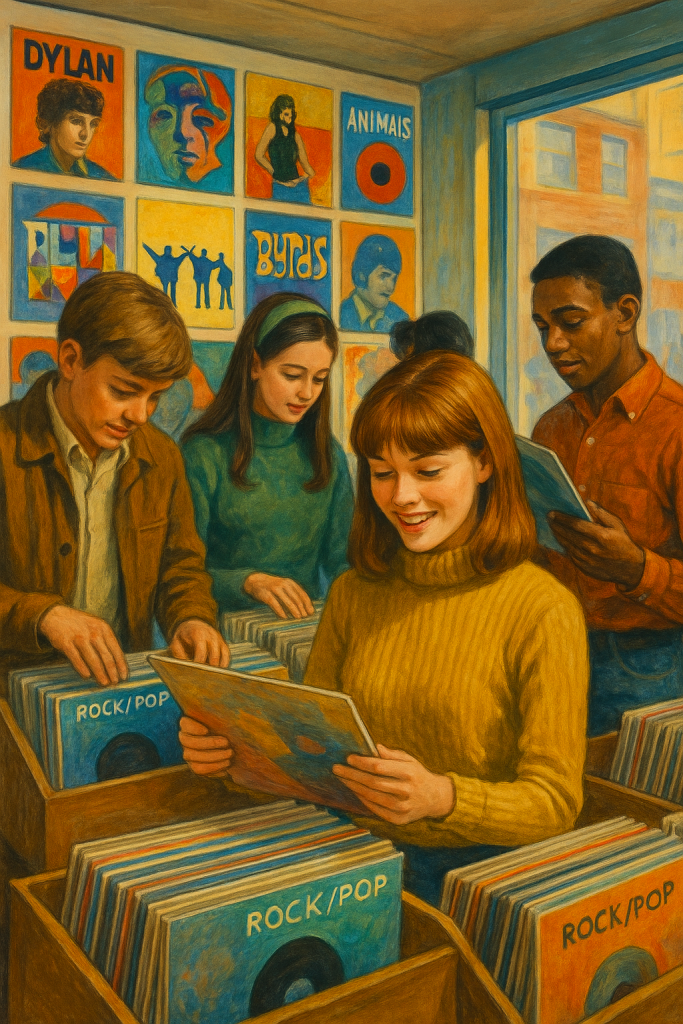
Music was how kids banded together. When was the new Beatles single being released? Who was the next wave of the British invasion? It didn’t matter if you were into Herman’s Hermits or Chet Baker. It’s where you received these musical telegrams from around the world. Richard Branson started his Virgin Records empire by building stores that featured … bean bag chairs. People were free to hang out, listen and connect, something that has been destroyed by the Spotify algorithms

The 1970’s were all about the roller rink and the disco.
The dance floor for suburban America. Funk, disco, the Bee Gees, flashing lights, and teenage awkwardness. It was all about meetups, first skates and first kisses.

The 1980’s were all about hanging out at the mall
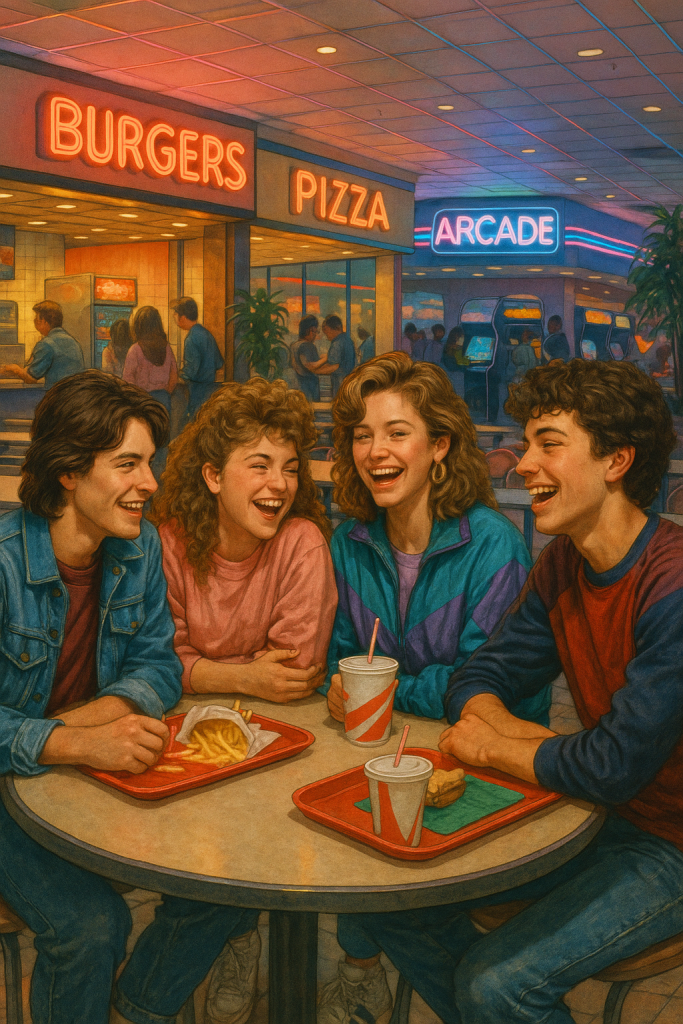
You didn’t have to have money. You just needed a ride. The food court, B. Dalton books, the arcade, Spencer Gifts. The mall offered a place to congregate, talk and try your first cigarette.

Do you see where I’m going with this? Most places that offered a place to gather, talk, gossip, and social trial and error are evaporating. The tables at the food court mall have been replaced by the blue screen glow of Discord, You Tube and Online Gaming Communities. And I’ve written about how dangerous those “Communities” offering “Connection” are for early teens.

The problem isn’t that our kids are different. It’s that their world is smaller.
The places where we learned to screw up, hang out, and figure ourselves out are gone, replaced by digital bubbles.

They have no garages, no rinks, no back tables at the pizza joint where a kid could just be a kid. I dare you to try to get your Home Owner’s Association to approve your garage as your kid’s rock band rehearsal space. Manicured order is now more important that creative discovery.

Our kids are struggling with social belonging and risk because the cost of rejection is impossibly high in the age of the public meme. But genuine human connection and development requires vulnerability.

By helping our sons discover their own third space, a place where he is valued for his genuine interests, not his grades or his digital clout, you give him a low-pressure environment to practice vulnerability. He learns to connect shoulder-to-shoulder over a shared activity, which is often easier for boys than face-to-face deep talk.
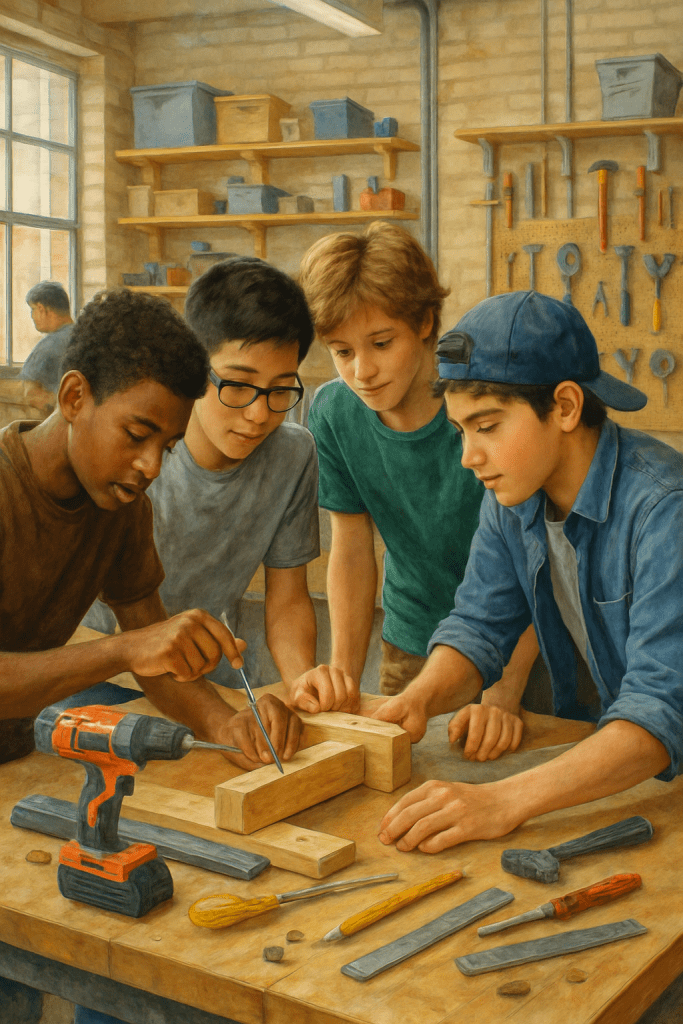
A third space might be a garage band, a gaming club, a skate park, a robotics group, or a small group that meets at the local coffee shop. It doesn’t need to be structured, monetized, or productive. It just needs to exist, somewhere they can laugh, fail, and belong without judgment.

This is more than just about making friends; it’s about building the emotional muscle to navigate the world. Let’s lead the way by showing them that having a community is the foundation of a resilient life. Let’s give them the car, the record store, or the garage, and let them start building.


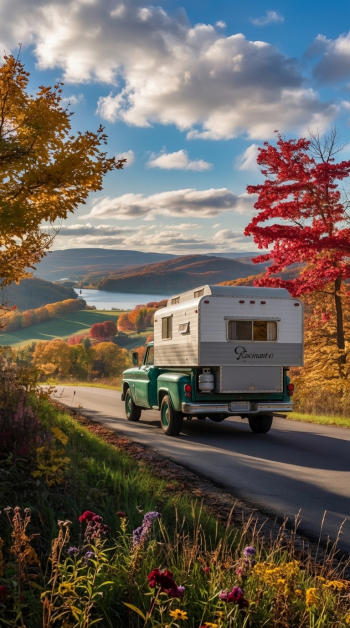
Social isolation among young men is rising fast. The fix isn’t another app, it’s giving boys back the time and places where they can just be kids.

There’s an epidemic affecting our sons. And it is just as dangerous as any physical, mental, digital or chemical threat they face growing up. It’s called the “male loneliness epidemic”. Among young men, specifically those in their teens to early thirties, social isolation and feelings of loneliness are rapidly on the rise. In one State of American Men Survey (Equimundo 2023), the majority of men surveyed agreed with the statement “No one really knows me at all.” In the US Surgeon General 2023 report, Surgeon General Vivek Murthy warned the public about “our epidemic of loneliness and isolation” framing it as a public health crisis.

How is this manifesting in our kids? 45% of boys aged 18 – 24 have never asked a girl out on a date in person. I get it. It’s always been difficult for a boy to muster the courage to ask a girl out. It makes them extremely vulnerable. And in today’s digital world, asking a girl out (and her saying no) runs the risk of becoming a very public and very embarrassing meme to be passed around and taunted. I’ve written about our kids becoming socially risk averse in my post Why Our Kids Don’t Trust Anyone Anymore (Thanks to the 24/7 Camera) (Click to read).

So what’s contributing to this loneliness epidemic in our kids?

1.) Big Tech, Social Media and Digital Entertainment.
In a world that proclaims global connectivity, our kids are less connected than ever. Social media, messaging, digital streaming entertainment and games are always on. They are always there to pacify and distract. Let’s face it, true human interaction and connection is difficult. “Being there” for a friend in need is difficult. But digital media lets our kids avoid tough situations and conversations. And when our kids don’t experience adversity, they don’t build empathy. Take a look at our kids’ social media feeds and see how many are cheering that organizations like US Aid and the cut off of SNAP benefits to the elderly are being cut. When human connection is removed, empathy dies.

2.) Overscheduling and Resume Building
We need to take responsibility for overscheduling our kids; sports, tutoring, AP Classes, SAT Test prep, scouts, leadership club and a myriad of other activities cram our schedules in the name of resume building. I’ve got news for you, it doesn’t work. Piling on and stacking our kids’ schedules in the hope of getting into a top tier school only leads to kids that are burnt out and have very little human connection. They have a lot of colleagues, but very few friends.

3.) Lack of a Third Space
This is probably one of the most overlooked needs of our children today. Why? Because it’s completely frivolous. There is no return on investment.
When we were teens, my brother Thomas was NEVER in the house. He was always in the garage, taking apart his car. Taking apart the engine, rebuilding the engine. Putting it together then taking it apart again. Week nights and every weekend he was in the garage. And that’s where his friends were too. Each night they were here or at a friend’s house working on their beat to shit cars. But Thomas never went into the auto industry as a profession. He’s in sales. The garage was his third space. Even today it is where he can be found.

Let’s talk about the concept of third spaces, their disappearance and the effect it’s having on our kids. What’s a third space, you ask? It’s a place outside of home (first space) and work/school (second space) where people can go and belong to a community, no matter how large or small. Traditional third spaces can be a gym, a hobby club, a religious community, recreational sports league, coffee shop or pub. It’s a space where a group of people can congregate and just connect.

Every generation has their version of a third space. It helps them be a part of something.

The 1950’s was all about car culture. The film American Graffiti captured this perfectly, kids in cars, radios at full volume circling the town for hours meeting and making friends.

The 1960’s was all about the record store

Music was how kids banded together. When was the new Beatles single being released? Who was the next wave of the British invasion? It didn’t matter if you were into Herman’s Hermits or Chet Baker. It’s where you received these musical telegrams from around the world. Richard Branson started his Virgin Records empire by building stores that featured … bean bag chairs. People were free to hang out, listen and connect, something that has been destroyed by the Spotify algorithms

The 1970’s were all about the roller rink and the disco.
The dance floor for suburban America. Funk, disco, the Bee Gees, flashing lights, and teenage awkwardness. It was all about meetups, first skates and first kisses.

The 1980’s were all about hanging out at the mall

You didn’t have to have money. You just needed a ride. The food court, B. Dalton books, the arcade, Spencer Gifts. The mall offered a place to congregate, talk and try your first cigarette.

Do you see where I’m going with this? Most places that offered a place to gather, talk, gossip, and social trial and error are evaporating. The tables at the food court mall have been replaced by the blue screen glow of Discord, You Tube and Online Gaming Communities. And I’ve written about how dangerous those “Communities” offering “Connection” are for early teens.

The problem isn’t that our kids are different. It’s that their world is smaller.
The places where we learned to screw up, hang out, and figure ourselves out are gone, replaced by digital bubbles.

They have no garages, no rinks, no back tables at the pizza joint where a kid could just be a kid. I dare you to try to get your Home Owner’s Association to approve your garage as your kid’s rock band rehearsal space. Manicured order is now more important that creative discovery.

Our kids are struggling with social belonging and risk because the cost of rejection is impossibly high in the age of the public meme. But genuine human connection and development requires vulnerability.

By helping our sons discover their own third space, a place where he is valued for his genuine interests, not his grades or his digital clout, you give him a low-pressure environment to practice vulnerability. He learns to connect shoulder-to-shoulder over a shared activity, which is often easier for boys than face-to-face deep talk.

A third space might be a garage band, a gaming club, a skate park, a robotics group, or a small group that meets at the local coffee shop. It doesn’t need to be structured, monetized, or productive. It just needs to exist, somewhere they can laugh, fail, and belong without judgment.

This is more than just about making friends; it’s about building the emotional muscle to navigate the world. Let’s lead the way by showing them that having a community is the foundation of a resilient life. Let’s give them the car, the record store, or the garage, and let them start building.

4 responses to “The Male Loneliness Epidemic: Why Our Sons Are Growing Up Without Real Friends”

  1. The Male Loneliness Epidemic: Our Sons Are Trading Human Connection for Digital Substitutes – DAD BOD WEEKLY Avatar

    […] In my last post, I talked about the rising epidemic of male loneliness. I mentioned how important it is for kids, especially boys, to have a “third space”, somewhere outside of home and school where they can actually hang out and connect with others face-to-face. Here is where they grow and learn. They learn how to listen, to talk, to face the tough issues and develop empathy. (If you want to read that post, click here) […]

    Like

  2. No Headphones November: The 30-Day Challenge to Reconnect With Real Life – DAD BOD WEEKLY Avatar

    […] I’ve written several times about the male loneliness epidemic confronting our sons and daughters. If you’d like to read those posts, you can find them here:The Male Loneliness Epidemic: Our Sons Are Trading Sex for Digital Substitutes. The Male Loneliness Epidemic: Why Our Sons Are Growing Up Without Real Friends […]

    Like

  3. Don’t Panic: What The Hitchhiker’s Guide to the Galaxy Teaches Kids About Flexibility, Meaning, and Surviving a Chaotic World – DAD BOD WEEKLY Avatar

    […] form of a friend group. It can be in the form of having a third place to get away and decompress (I wrote about the need for third spaces here). The book reminds us that life is an adventure, not an itinerary. And every setback is an […]

    Like

  4. Australia Banned Social Media for Kids under 16, And Honestly, We Should Too. – DAD BOD WEEKLY Avatar

    […] addictive algorithms. You’ve seen my rants against ROBLOX (Read it here), Male Loneliness (Read it here) and the unhealthy relationships developed online (Read it here). Getting kids off social media […]

    Like

Leave a comment