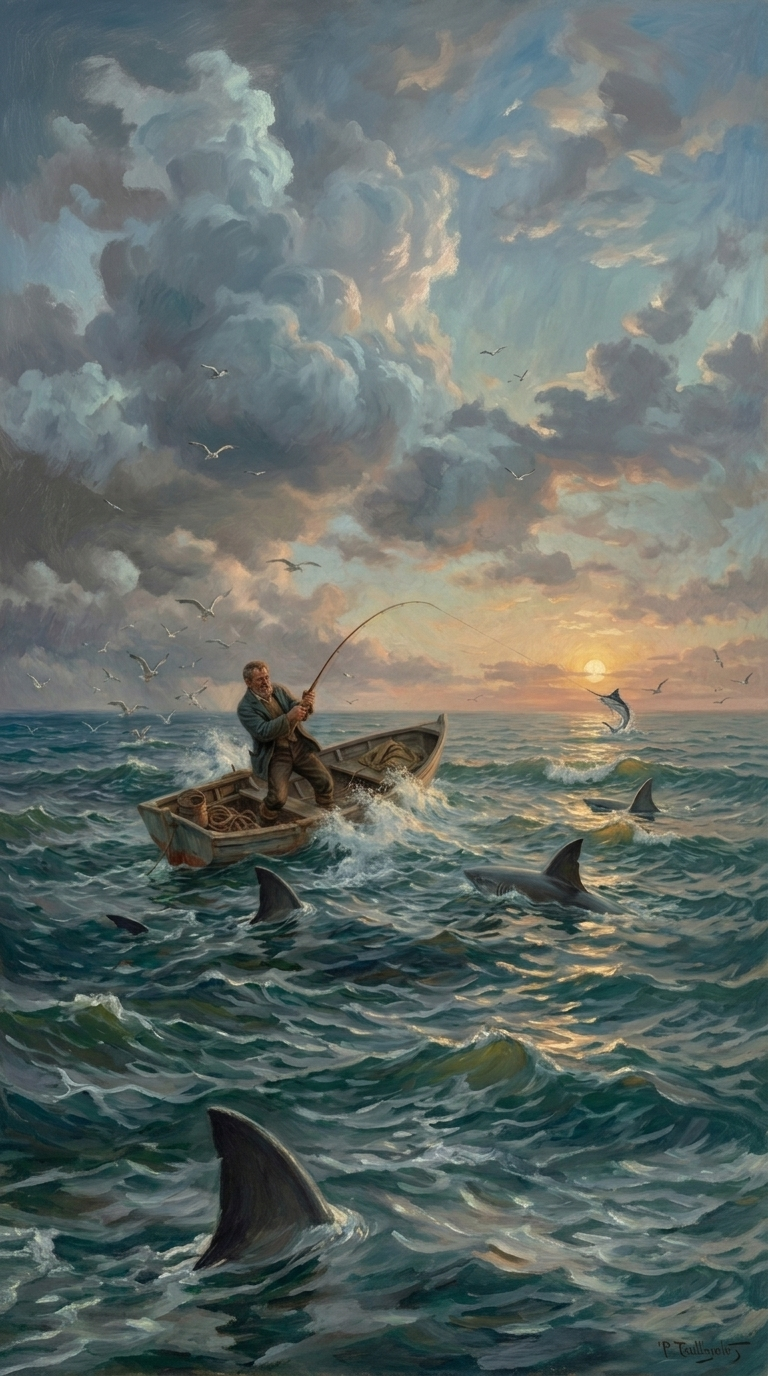
The Old Man and The Sea by Hemmingway

Why an 84-day losing streak, a stubborn old fisherman, and a fish he never gets to keep might be the antidote to a generation raised on instant gratification.

We all know our children are growing up in an age of instant gratification filled with entertainment on demand, instant package delivery, gaming distraction, social media dopamine hits that eliminate boredom, difficult and uncomfortable feelings and an easy pivot to the easy option.

And we reinforce this mindset without realizing it. When conflict enters our children’s lives, we rush in to resolve it. When they struggle, we remove the obstacles. We mean well, but children who never learn to endure frustration may grow into adults who mistake difficulty for failure.

It’s why I write this blog. It’s also why I love going back to classic literature to rediscover the lessons we need to navigate this digital minefield.

This week, I explore why Hemingway’s The Old Man and the Sea still matters and holds valuable lessons our kids need to learn. 74 years after publication, Hemingway is teaching us: be consistent, believe in yourself, refuse to let any setback define who you are, and take those risks.

At the beginning of the novel, we meet Santiago, the “old man” as he describes himself. Santiago is a fisherman living in a modest shack on the shores of Cuba. He has gone eighty-four days without catching a fish. While those around him are succeeding, he returns each evening with an empty boat.

In our modern mindset, it’s easy for us, the reader, to tell Santiago to quit. If success doesn’t come quickly, pivot, move on. Do something that’s easier.

But Santiago refuses. Every single morning, before sunrise, he wakes up and goes to work. He maintains his sails, ropes, and fishing lines. He maintains his craft. As a side note, there is an incredible side lesson taught here. Every morning a small boy from the village joins him working on the boat. It’s a wonderful side theme of mentorship and passing down good habits. The boy’s parents no longer allow him to go on the boat with the old man. Those parents are telling the boy to look for immediate success.

Hemingway is teaching us about consistency. It’s easy to be consistent when life goes well. The true test of character comes during the rough patches. It’s more difficult to be consistent when there is no instant reward. No dopamine hit. And our kids will experience these rough patches throughout their lives. They’ll struggle in school, not make first string varsity sports, get rejected by an amore, start and stall careers. There will be many times they will doubt if their work pays off.

Santiago’s eighty-four days of no catches aren’t a call to quit. They’re a lesson that success may come on day eighty-five. On day eighty-five, Santiago tells us:

“I keep them (his fishing lines) with precision. Only I have no luck anymore. But who knows? Maybe today. Every day is a new day.”


Hemingway is teaching us the value of consistency. He wants us to take a long view. Let’s teach our kids to look beyond the instant dopamine hit.

On the eighty-fifth day, Santiago takes a risk. He rows his small skiff beyond the regular waters where other fishermen work. He pushes into deeper, and more dangerous territory.

He is taking a calculated bet.

He believes the safe and crowded waters have been thoroughly fished. If he wants to do something significant, he must go where the others aren’t willing. He understands that the greater the risk may yield the greater reward. A great life lesson for our kids.

And Santiago isn’t acting impulsively or recklessly. He weighed the options and prepared the proper equipment. He measures his lines and casts them in an organized methodical way. He is thinking independently, weighing the risks and options, and decides the difficult route is still worth taking.

Our kids can use that same freedom of independent thinking. They need opportunities to try new activities, have new experiences, and share new ideas. They need to set their own goals, even if they may not pay off. Santiago knows that fishing in the safe waters will never give him the opportunity to hook the fifteen-hundred-pound marlin.

Santiago’s risk allows him to hook an enormous marlin. The fish is more powerful than his small skiff sailboat. The fish refuses to surrender and pulls Santiago’s skiff deeper into the open waters. Eventually Santiago loses sight of his island. His hands are cut from holding the line, his body is cut, bruised and beaten, he is exhausted. His life is in danger.

As a reader, I thought Santiago should cut the line and let the marlin go. It seems like a sensible thing to do. But I missed the point.

Santiago says: “Fish, I love you and respect you very much. But I will kill you before this day ends.”

At this point, the story pivots from a sporting adventure tale to a lesson about commitment.

He has chosen this difficult task. He promises to see it through even though the commitment is filled with pain, anxiety, uncertainty, requires a massive amount of work, is lonely, and success is still uncertain.

That’s the beautiful conversation we should have with our children. Not every risk will pay off. And every choice they make will come with consequences, even if they are uncomfortable.

Santiago eventually kills the marlin. He battled against the fish for two and a half days. The death of the fish should feel like a clean victory. It’s a logical place for the book to end. The old man hooked the biggest fish. It’s the perfect feel good after school special ending.

But then we would miss the point.

So Hemingway doesn’t stop there. The marlin is too large to fit in his small skiff. He resorts to tying it to the side of his boat. He begins the long two-and-a-half-day journey home. But the blood from the fish spreads through the water, attracting a swarm of sharks from miles away. Santiago knows he can’t fight them all. He knows the sharks will get most of his trophy.

One by one, they tear into the marlin.

Santiago fights the sharks with anything he can get his hands on, his harpoon breaks, then he ties a knife to an oar, and finally his own two hands. He knows he cannot defeat every shark. He knows the fish will probably be stripped apart before he reaches land.

For the second time, I am telling Santiago to cut the fish loose. It’s not worth it. Quit.

Why fight when the reward is disappearing? He can’t take the fish to the market. So, what is the point? Why keep risking his safety?

But I’m still missing the point.

Santiago answers with the novel’s most important line:

“A man can be destroyed but not defeated.”

Now Santiago is no longer thinking about how much money the fish will make at the market. He’s no longer thinking about bragging rights. The only thing he is thinking about is completing the job to the best of his abilities. The result isn’t going to be what he originally set out to do. But he’s not quitting. He may be destroyed, but he’s not defeated. Quitting is the defeat.

Santiago returns without the marlin meat, but he knows that he did the best job he could. He is staying consistent with his core belief system:

Everyday he gets up and goes to work.

Everyday he thinks for himself and explores new territory.

Every day he completes the work and doesn’t quit, no matter how difficult the job becomes.

And that’s the lesson we need to teach our kids:

Be consistent
Beleive in yourself
Never give up on yourself


In today’s digital age, the score is the only story that matters. We tally follower counts, grades, and college admissions. The stats have become the story of our lives. But, when the desired outcome doesn’t happen, our kids sense of self-worth can collapse.

Santiago demonstrates the best way to evaluate our lives.

Did we show up consistently?

Did we believe in ourselves?

Did we take a risk instead of always choosing the safest path?

Did we complete the work with integrity?

Did we keep going when the reward began to disappear?

Our kids won’t win every game, earn every grade, or reach every goal. No amount of parental protection can do that. What we can do is help them separate disappointment from defeat.

They can lose the game without becoming losers. They can fail an exam without becoming failures. They can watch a goal slip away and still take pride in how they worked toward it.

That is the message Hemingway is giving us. You can fail at the task and still not be defeated.

Seventy-four years after its publication, The Old Man and the Sea still delivers a powerful lesson for our kids. Life will include dry spells. Risks mean hard work. There will be failures. Hard work won’t always produce the outcome we hoped for. But we still get up, go back to work, and venture into new territory. And when the sharks come, we hold the line for as long as we can.

That’s the lesson our children need:

Be consistent.

Believe in yourself.

And don’t let one loss decide who you are.

Leave a Reply