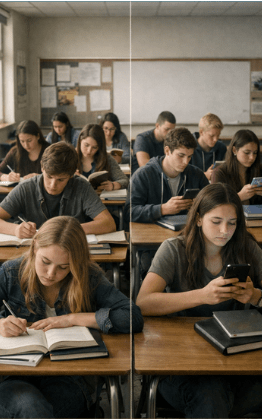
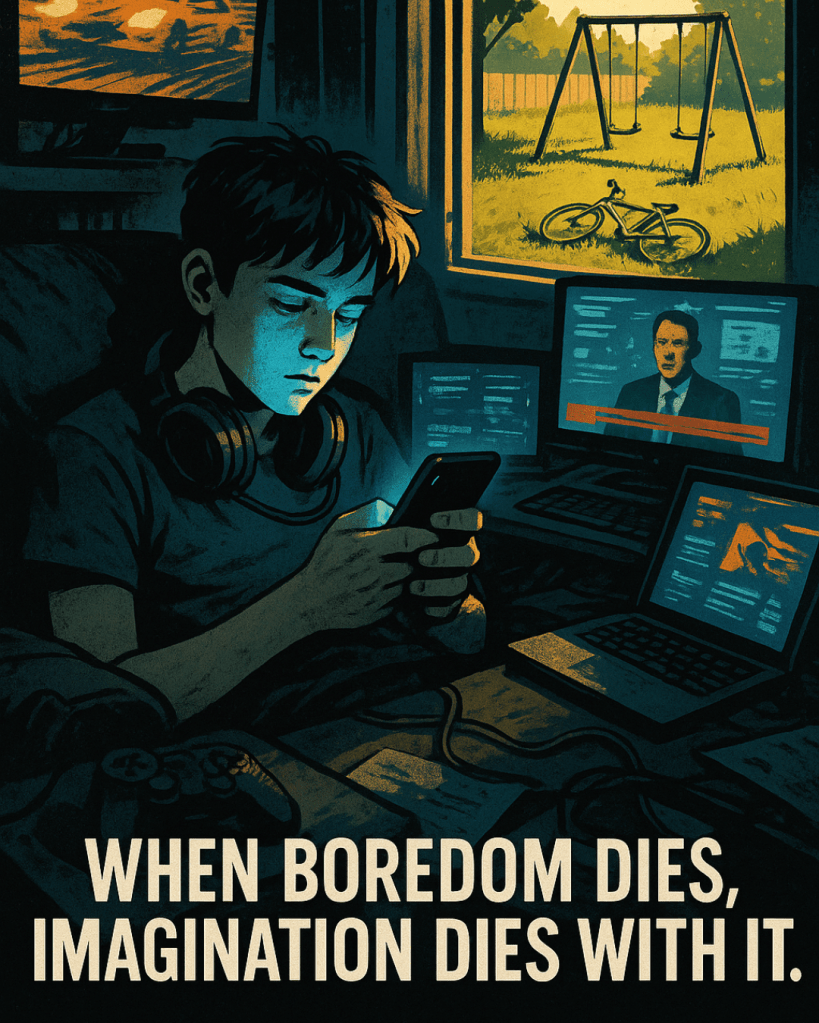
Teen boy glued to his phone inside while a bright, inviting summer day sits untouched outside.

Parents killed boredom. Screens buried it. And now a generation of teens is paying the price. How constant stimulation, overscheduling, and our own bad habits are robbing teens of resilience, creativity, and independence
My fifteen-year-old son shuffled into the kitchen. Gym shorts, no shirt.  

“I’m bored.” 

I was tempted to answer this way: 

“You can pick up a book and read it. Or go for a run. Maybe text your friends to hang out? Go to Target and pick up a few things for me. Cut the lawn for me. Do you want to learn how to change the oil in my car? There’s that art project you mentioned.” 

The way I answered was: 

“Not my problem,” as I flipped through my current month’s edition of The Atlantic. 

“Never mind,” he muttered, grabbing an old Eggo left over from breakfast as he shuffled back to his room. 

With answer number one, I would have treated his boredom as my problem to fix. If I went unchecked, I could have scheduled the entire day for him. And in doing so, I would reinforce the exact thing I’m fighting against the idea that every moment needs to be filled, every silence needs a soundtrack, every idle second needs an app.  

The Boredom Crisis. Our kids aren’t bored enough.  

Here’s the problem, our kids have access to more entertainment on demand than any generation in human history. However, they are more anxious, and unable to sit still. They are uncomfortable in their own skin. With a click of a button our kids can watch any movie ever released, talk with friends, or watch cat videos until their eyes glaze over. Yet they are still bored. 

The problem isn’t lack of options. It’s that their brains have been trained to expect constant stimulation. Every app is engineered to deliver dopamine hits on demand. TikTok perfected the algorithm that ensures you never have to wait more than fifteen seconds for something interesting. Instagram refreshes new content every time you pull down. Even texting creates micro-rewards with every ping and buzz. 

Boredom has become intolerable because we’ve built a world that promises it never has to exist. 

Video may have killed the radio star, but we parents have killed the important need for boredom, specifically down time. Our kids schedules are packed with no time to 

just….be…. still. 

Early period study hall, school time, soccer practice, after school tutoring, homework, next day prep, bed.  

When we were growing up, boredom was part of the summer. Long stretches of nothing happening. Early weeks of summer were fresh as we spent the days at the community pool. Mid-summer meant dad’s two weeks of vacation, and we all stuffed into the family station wagon for a road trip to some campground. But at the end of summer, the dog days were filled with …. nothing.  

Long weeks of nothing happening. Mom would kick us outside and give strict instructions to not come back until dinner. We’d wander the neighborhood, run through the woods, ride bikes to other parts of the neighborhood and join pick up football games. We had no choice. Get up and make something happen.  

Self-reliance, creativity, and independence don’t emerge from artificial stimulation. They emerge from the empty spaces. They grow like seeds poking out from the restlessness and need to fill silence with something of our own making. In other words, the silence breeds action. While the noise of stimulation breeds silence. It’s active discovery vs, passive entropy.  

I got my first job on my 16th birthday, bought my first guitar at 17, my first car at 18 and took my first 1,500 mile road trip three days before I graduated high school ( I made it back home 2 hours before the graduation ceremony started) All because I was bored.  

Boredom is the laboratory where we figure out who we are, what we care about and, who we want to be.  

Boredom pushes problem-solving. When you need to fix your bike, you have to think it through yourself, try things, fail, adapt. Yes, YouTube can help. But that’s not doom scrolling.  

Most importantly, boredom teaches us to be alone without being lonely. To sit with our own thoughts. To daydream. To develop an inner life that doesn’t require an audience or validation. That’s pure freedom. That’s human growth. 

Our kids are losing all of this, one scroll at a time. 

But unfortunately, we, the parents, are part of the problem. Before I get too preachy, I have admit I was complicit in all of this. 

I overscheduled my kids because I thought college applications expected a resume that looks like a CEO’s LinkedIn profile. Club sports, volunteer work, AP classes, music lessons, test prep, we’ve packed their lives so full that unstructured time feels like wasted opportunity. 

We fear that if our kids aren’t constantly productive or connected, they’ll fall behind. Behind what, exactly? I’m not sure. But the anxiety is real. 

I’m not suggesting we throw all the phones in a lake and go full Little House on the Prairie. That’s not realistic, and honestly, it’s not even desirable. Technology isn’t the enemy, it’s the constant, uninterrupted access that’s the problem. 

But I struggled with the question: “How do I solve this problem with my kids.” And in a quiet moment, it hit me. I am part of the problem. I need to fix my habits first. So, for the last thirty days, I’ve been trying to make changes in my habits. Hopefully these will be noticed and adapted by my kids. 

First, and most difficult, I am resisting the urge to solve boredom, mine and my family’s. It feels harsh at first, and kids can get frustrated at your lack of a solution. But I’m not their entertainment director. 

Second, I need to normalize and model the act of doing nothing. Sometimes I sit on the back patio with my snacks and just… sit. No phone, no book, no project. My kids aren’t ready for this step. And they think it’s weird, which tells me they need to see it more. “I’m just sitting enjoying the morning looking at the birds. The message is clear, downtime is a valid use of time. 

Third, I started getting more protective of my calendar. I’ve started saying no to activities that fill every weekend. I now have a “do nothing Sunday”. After church I just hang around the house. No plans, no agenda. And it’s GREAT! 

Because maybe teaching our kids to be bored, to sit with themselves, to create from nothing, to find contentment in stillness, is one of the most important things we can do as parents in this frantically overstimulated world. 

Maybe boredom isn’t a problem to solve. Maybe it’s a gift we need to learn (again) how to give. My fifteen-year-old son shuffled into the kitchen. Gym shorts, no shirt.

“I’m bored.”

I was tempted to answer this way:

“You can pick up a book and read it. Or go for a run. Maybe text your friends to hang out? Go to Target and pick up a few things for me. Cut the lawn for me. Want to learn how to change the oil in my car? There’s that art project you mentioned.”

The way I actually answered was:

“Not my problem,” as I flipped though my current month’s edition of The Atlantic.

“Never mind,” he muttered grabbing an old Eggo left over from breakfast as he shuffled back to his room.

With answer number one, I would have treated his boredom as my problem to fix. If I went unchecked, I could have scheduled the entire day for him. And in doing so, I would reinforce the exact thing I’m fighting against: the idea that every moment needs to be filled, every silence needs a soundtrack, every idle second needs an app.

The Boredom Crisis. Our kids aren’t bored enough.

Here’s the problem, our kids have access to more entertainment on demand, than any generation in human history. However, they are more anxious, and unable to sit still. They are uncomfortable in their own skin. With a click of a button our kids can watch any movie ever released, talk with friends, or watch cat videos until their eyes glaze over. Yet they are still bored.

The problem isn’t lack of options. It’s that their brains have been trained to expect constant stimulation. Every app is engineered to deliver dopamine hits on demand. TikTok perfected the algorithm that ensures you never have to wait more than fifteen seconds for something interesting. Instagram refreshes with new content every time you pull down. Even texting creates micro-rewards with every ping and buzz.

Boredom has become intolerable because we’ve built a world that promises it never has to exist.

Video may have killed the radio star, but we parents have killed the important need for boredom, specifically down time. Our kids schedules are packed with no time to

just….be….still.

Early period study hall, school time, soccer practice, after school tutoring, homework, next day prep, bed.

When we were growing up, boredom was part of the summer. Long stretches of nothing happening. Early weeks of summer were fresh as we spent the days at the community pool. Mid summer meant dad’s two weeks of vacation and we all stuffed into the family station wagon for a road trip to some campground. But the end of summer, the dog days, were filled with …. nothing.

Long weeks of nothing happening. Mom would kick us outside and give strict instructions to not come back until dinner. We’d wander the neighborhood, run though the woods, ride bikes to other parts of the neighborhood and join pick up football games. We had no choice. Get up and make something happen.

Self reliance, creativity and independence don’t emerge from artificial stimulation. They emerge from the empty spaces. The grow like seeds poking out from the restlessness and need to fill silence with something of our own making. In other words, the silence breeds action. While the noise of stimulation breeds silence. It’s active discovery vs, passive entropy.

I got my first job on my 16th birthday, bought my first guitar at 17, my first car at 18 and took my first 1,500 mile road trip three days before I graduated high school ( I made it back home 2 hours before the graduation ceremony started) All because I was bored.

Boredom is the laboratory where we figure out who we are, what we care about and, who we want to be.

Boredom pushes problem-solving. When you need to fix your bike, you have to think it through yourself, try things, fail, adapt. Yes, YouTube can help. But that’s not doom scrolling.

Most importantly, boredom teaches us to be alone without being lonely. To sit with our own thoughts. To daydream. To develop an inner life that doesn’t require an audience or validation. That’s pure freedom. That’s human growth.

Our kids are losing all of this, one scroll at a time.

But unfortunately we, the parents, are part of the problem. Before I get too preachy, I have admit: I was complicit in all of this.

I overscheduled my kids because I thought college applications expected a resume that looks like a CEO’s LinkedIn profile. Club sports, volunteer work, AP classes, music lessons, test prep, we’ve packed their lives so full that unstructured time feels like wasted opportunity.

We fear that if our kids aren’t constantly productive or connected, they’ll fall behind. Behind what, exactly? I’m not sure. But the anxiety is real.

I’m not suggesting we throw all the phones in a lake and go full Little House on the Prairie. That’s not realistic, and honestly, it’s not even desirable. Technology isn’t the enemy, it’s the constant, uninterrupted access that’s the problem.

But I struggled with the question: “How do I solve this problem with my kids.” And in a moment of quiet it hit me. I am part of the problem. I need to fix my habits first. So for the last thirty days, I’ve been trying to make changes in my habits. Hopefully these will be noticed and adapted by my kids.

First, and most difficult, I am resisting the urge to solve boredom, mine and my family’s. It feels harsh at first, and kids can get frustrated at your lack of a solution. But I’m not their entertainment director.

Second, I need to normalize and model the act of doing nothing. Sometimes I sit on the back patio with my snacks and just… sit. No phone, no book, no project. My kids aren’t ready for this step. And they think it’s weird, which tells me they need to see it more. “I’m just sitting enjoying the morning looking at the birds. The message is clear, downtime is a valid use of time.

Third, I started getting more protective of my calendar. I’ve started saying no to activities that fill every weekend. I now have a “do nothing Sunday”. After church I just hang around the house. No plans, no agenda. And it’s GREAT!

Because maybe teaching our kids to be bored, to sit with themselves, to create from nothing, to find contentment in stillness, is one of the most important things we can do as parents in this frantically overstimulated world.

Maybe boredom isn’t a problem to solve. Maybe it’s a gift we need to learn (again) how to give.


Parents killed boredom. Screens buried it. And now a generation of teens is paying the price. How constant stimulation, overscheduling, and our own bad habits are robbing teens of resilience, creativity, and independence

My fifteen-year-old son shuffled into the kitchen. Gym shorts, no shirt.  

“I’m bored.” 

I was tempted to answer this way: 

“You can pick up a book and read it. Or go for a run. Maybe text your friends to hang out? Go to Target and pick up a few things for me. Cut the lawn for me. Do you want to learn how to change the oil in my car? There’s that art project you mentioned.” 

The way I answered was: 

“Not my problem,” as I flipped through my current month’s edition of The Atlantic. 

“Never mind,” he muttered, grabbing an old Eggo left over from breakfast as he shuffled back to his room. 

With answer number one, I would have treated his boredom as my problem to fix. If I went unchecked, I could have scheduled the entire day for him. And in doing so, I would reinforce the exact thing I’m fighting against the idea that every moment needs to be filled, every silence needs a soundtrack, every idle second needs an app.  

The Boredom Crisis. Our kids aren’t bored enough.  

Here’s the problem, our kids have access to more entertainment on demand than any generation in human history. However, they are more anxious, and unable to sit still. They are uncomfortable in their own skin. With a click of a button our kids can watch any movie ever released, talk with friends, or watch cat videos until their eyes glaze over. Yet they are still bored. 

The problem isn’t lack of options. It’s that their brains have been trained to expect constant stimulation. Every app is engineered to deliver dopamine hits on demand. TikTok perfected the algorithm that ensures you never have to wait more than fifteen seconds for something interesting. Instagram refreshes new content every time you pull down. Even texting creates micro-rewards with every ping and buzz. 

Boredom has become intolerable because we’ve built a world that promises it never has to exist. 

Video may have killed the radio star, but we parents have killed the important need for boredom, specifically down time. Our kids schedules are packed with no time to 

just….be…. still. 

Early period study hall, school time, soccer practice, after school tutoring, homework, next day prep, bed.  

When we were growing up, boredom was part of the summer. Long stretches of nothing happening. Early weeks of summer were fresh as we spent the days at the community pool. Mid-summer meant dad’s two weeks of vacation, and we all stuffed into the family station wagon for a road trip to some campground. But at the end of summer, the dog days were filled with …. nothing.  

Long weeks of nothing happening. Mom would kick us outside and give strict instructions to not come back until dinner. We’d wander the neighborhood, run through the woods, ride bikes to other parts of the neighborhood and join pick up football games. We had no choice. Get up and make something happen.  

Self-reliance, creativity, and independence don’t emerge from artificial stimulation. They emerge from the empty spaces. They grow like seeds poking out from the restlessness and need to fill silence with something of our own making. In other words, the silence breeds action. While the noise of stimulation breeds silence. It’s active discovery vs, passive entropy.  

I got my first job on my 16th birthday, bought my first guitar at 17, my first car at 18 and took my first 1,500 mile road trip three days before I graduated high school ( I made it back home 2 hours before the graduation ceremony started) All because I was bored.  

Boredom is the laboratory where we figure out who we are, what we care about and, who we want to be.  

Boredom pushes problem-solving. When you need to fix your bike, you have to think it through yourself, try things, fail, adapt. Yes, YouTube can help. But that’s not doom scrolling.  

Most importantly, boredom teaches us to be alone without being lonely. To sit with our own thoughts. To daydream. To develop an inner life that doesn’t require an audience or validation. That’s pure freedom. That’s human growth. 

Our kids are losing all of this, one scroll at a time. 

But unfortunately, we, the parents, are part of the problem. Before I get too preachy, I have admit I was complicit in all of this. 

I overscheduled my kids because I thought college applications expected a resume that looks like a CEO’s LinkedIn profile. Club sports, volunteer work, AP classes, music lessons, test prep, we’ve packed their lives so full that unstructured time feels like wasted opportunity. 

We fear that if our kids aren’t constantly productive or connected, they’ll fall behind. Behind what, exactly? I’m not sure. But the anxiety is real. 

I’m not suggesting we throw all the phones in a lake and go full Little House on the Prairie. That’s not realistic, and honestly, it’s not even desirable. Technology isn’t the enemy, it’s the constant, uninterrupted access that’s the problem. 

But I struggled with the question: “How do I solve this problem with my kids.” And in a quiet moment, it hit me. I am part of the problem. I need to fix my habits first. So, for the last thirty days, I’ve been trying to make changes in my habits. Hopefully these will be noticed and adapted by my kids. 

First, and most difficult, I am resisting the urge to solve boredom, mine and my family’s. It feels harsh at first, and kids can get frustrated at your lack of a solution. But I’m not their entertainment director. 

Second, I need to normalize and model the act of doing nothing. Sometimes I sit on the back patio with my snacks and just… sit. No phone, no book, no project. My kids aren’t ready for this step. And they think it’s weird, which tells me they need to see it more. “I’m just sitting enjoying the morning looking at the birds. The message is clear, downtime is a valid use of time. 

Third, I started getting more protective of my calendar. I’ve started saying no to activities that fill every weekend. I now have a “do nothing Sunday”. After church I just hang around the house. No plans, no agenda. And it’s GREAT! 

Because maybe teaching our kids to be bored, to sit with themselves, to create from nothing, to find contentment in stillness, is one of the most important things we can do as parents in this frantically overstimulated world. 

Maybe boredom isn’t a problem to solve. Maybe it’s a gift we need to learn (again) how to give. My fifteen-year-old son shuffled into the kitchen. Gym shorts, no shirt.

“I’m bored.”

I was tempted to answer this way:

“You can pick up a book and read it. Or go for a run. Maybe text your friends to hang out? Go to Target and pick up a few things for me. Cut the lawn for me. Want to learn how to change the oil in my car? There’s that art project you mentioned.”

The way I actually answered was:

“Not my problem,” as I flipped though my current month’s edition of The Atlantic.

“Never mind,” he muttered grabbing an old Eggo left over from breakfast as he shuffled back to his room.

With answer number one, I would have treated his boredom as my problem to fix. If I went unchecked, I could have scheduled the entire day for him. And in doing so, I would reinforce the exact thing I’m fighting against: the idea that every moment needs to be filled, every silence needs a soundtrack, every idle second needs an app.

The Boredom Crisis. Our kids aren’t bored enough.

Here’s the problem, our kids have access to more entertainment on demand, than any generation in human history. However, they are more anxious, and unable to sit still. They are uncomfortable in their own skin. With a click of a button our kids can watch any movie ever released, talk with friends, or watch cat videos until their eyes glaze over. Yet they are still bored.

The problem isn’t lack of options. It’s that their brains have been trained to expect constant stimulation. Every app is engineered to deliver dopamine hits on demand. TikTok perfected the algorithm that ensures you never have to wait more than fifteen seconds for something interesting. Instagram refreshes with new content every time you pull down. Even texting creates micro-rewards with every ping and buzz.

Boredom has become intolerable because we’ve built a world that promises it never has to exist.

Video may have killed the radio star, but we parents have killed the important need for boredom, specifically down time. Our kids schedules are packed with no time to

just….be….still.

Early period study hall, school time, soccer practice, after school tutoring, homework, next day prep, bed.

When we were growing up, boredom was part of the summer. Long stretches of nothing happening. Early weeks of summer were fresh as we spent the days at the community pool. Mid summer meant dad’s two weeks of vacation and we all stuffed into the family station wagon for a road trip to some campground. But the end of summer, the dog days, were filled with …. nothing.

Long weeks of nothing happening. Mom would kick us outside and give strict instructions to not come back until dinner. We’d wander the neighborhood, run though the woods, ride bikes to other parts of the neighborhood and join pick up football games. We had no choice. Get up and make something happen.

Self reliance, creativity and independence don’t emerge from artificial stimulation. They emerge from the empty spaces. The grow like seeds poking out from the restlessness and need to fill silence with something of our own making. In other words, the silence breeds action. While the noise of stimulation breeds silence. It’s active discovery vs, passive entropy.

I got my first job on my 16th birthday, bought my first guitar at 17, my first car at 18 and took my first 1,500 mile road trip three days before I graduated high school ( I made it back home 2 hours before the graduation ceremony started) All because I was bored.

Boredom is the laboratory where we figure out who we are, what we care about and, who we want to be.

Boredom pushes problem-solving. When you need to fix your bike, you have to think it through yourself, try things, fail, adapt. Yes, YouTube can help. But that’s not doom scrolling.

Most importantly, boredom teaches us to be alone without being lonely. To sit with our own thoughts. To daydream. To develop an inner life that doesn’t require an audience or validation. That’s pure freedom. That’s human growth.

Our kids are losing all of this, one scroll at a time.

But unfortunately we, the parents, are part of the problem. Before I get too preachy, I have admit: I was complicit in all of this.

I overscheduled my kids because I thought college applications expected a resume that looks like a CEO’s LinkedIn profile. Club sports, volunteer work, AP classes, music lessons, test prep, we’ve packed their lives so full that unstructured time feels like wasted opportunity.

We fear that if our kids aren’t constantly productive or connected, they’ll fall behind. Behind what, exactly? I’m not sure. But the anxiety is real.

I’m not suggesting we throw all the phones in a lake and go full Little House on the Prairie. That’s not realistic, and honestly, it’s not even desirable. Technology isn’t the enemy, it’s the constant, uninterrupted access that’s the problem.

But I struggled with the question: “How do I solve this problem with my kids.” And in a moment of quiet it hit me. I am part of the problem. I need to fix my habits first. So for the last thirty days, I’ve been trying to make changes in my habits. Hopefully these will be noticed and adapted by my kids.

First, and most difficult, I am resisting the urge to solve boredom, mine and my family’s. It feels harsh at first, and kids can get frustrated at your lack of a solution. But I’m not their entertainment director.

Second, I need to normalize and model the act of doing nothing. Sometimes I sit on the back patio with my snacks and just… sit. No phone, no book, no project. My kids aren’t ready for this step. And they think it’s weird, which tells me they need to see it more. “I’m just sitting enjoying the morning looking at the birds. The message is clear, downtime is a valid use of time.

Third, I started getting more protective of my calendar. I’ve started saying no to activities that fill every weekend. I now have a “do nothing Sunday”. After church I just hang around the house. No plans, no agenda. And it’s GREAT!

Because maybe teaching our kids to be bored, to sit with themselves, to create from nothing, to find contentment in stillness, is one of the most important things we can do as parents in this frantically overstimulated world.

Maybe boredom isn’t a problem to solve. Maybe it’s a gift we need to learn (again) how to give.

One response to “The Lost Art of Boredom: Why Our Overscheduled Kids Can’t Think, Create, or Sit Still Anymore”

  1. Australia Banned Social Media for Kids under 16, And Honestly, We Should Too. – DAD BOD WEEKLY Avatar

    […] days, but Australia wants to give their kids that space. Boredom is essential to kids development (read why here). (American Academy of […]

    Like

Leave a reply to Australia Banned Social Media for Kids under 16, And Honestly, We Should Too. – DAD BOD WEEKLY Cancel reply