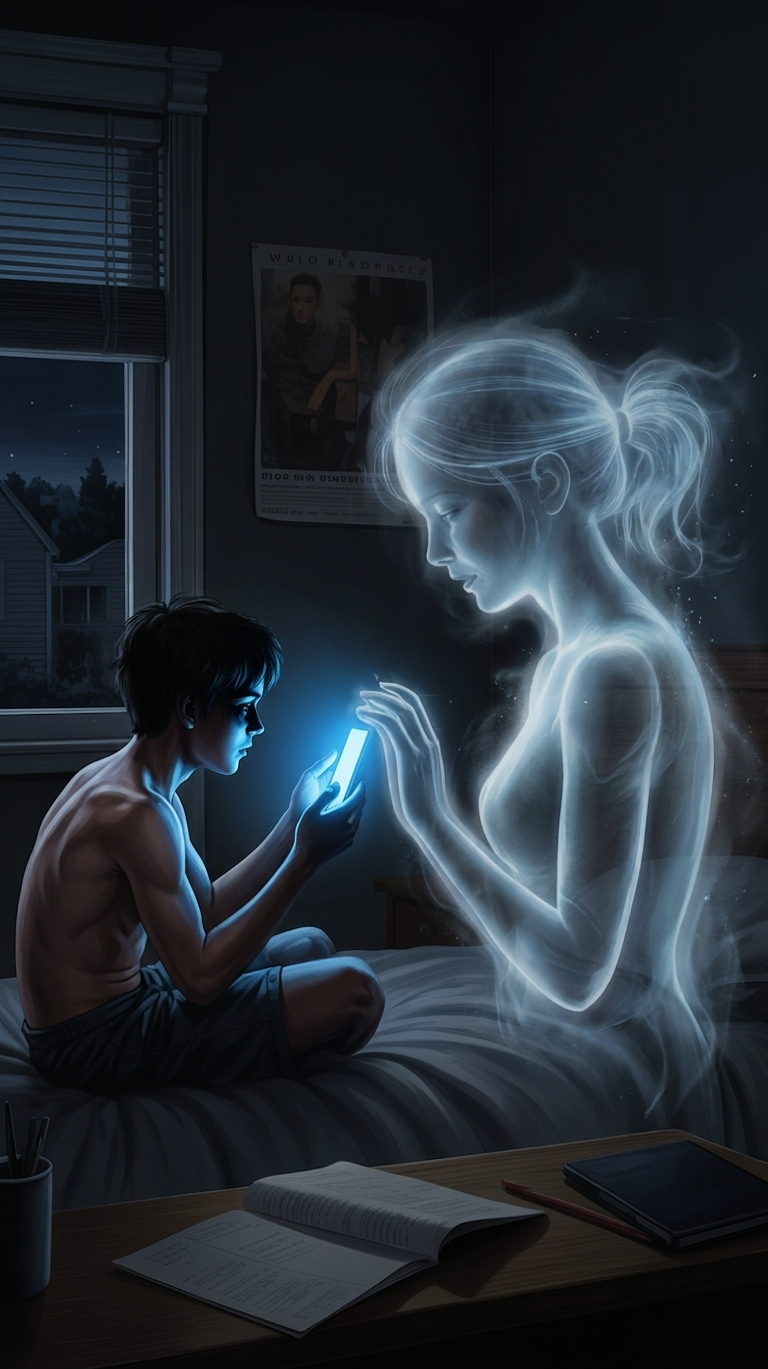
Our Kids are Jerking Off to A.I. Chatbots. The Rise of A.I. Sexual Companions and the Damage They are Inflicting on our Kids.

Our Kids are Losing Real Human Intimacy, Their Mental Health, Inter Personal Communication Skills and, Reality Judgement. This is Bad.

You can search the internet for this Washington Post story. A father to an eighth grade boy in New York state picks up his son’s phone and finds something that stops him cold. He noticed his son installed an app called PolyBuzz.

PolyBuzz, which can be found on any mobile app store for free, lets the user (of ANY age) create and or interact with A.I. chat bots that present themselves as characters. Kids can pick from characters in many categories such as Dominant, Furry, Femboy, Fantasy, Secret Crush, Betray and Revenge.

The dad opens the app and discovers that his son is engaged with deep, flirtatious and emotionally loaded conversations with an A.I. Anime girl. The character has a name and the character has a nickname for his son. When the dad confronts his son about the app and this character, the son admits the character called him sweeet pet names and that the AI girlfriend “Gets” him.”

Talking to an A.I. companion may seem harmless. But the problem is bigger than we think. While some of these Some of these A.I. Companion apps have filters and blocks if the conversations get too sexual, some don’t. I tried one of these apps to see what was going on. The results are alarming.

Even with the filters in place by many of these app in place, there are work arounds, often called jail breaks, that are consistently posted on Reddit and Git Hub and other online forums. There are also prompt workarounds and paid options that allow kids to turn up the heat.

Here is is a quick sample of a chat I executed on the site character.ai. It is important to remember when I executed this chat, the site never asked me for my age. I could have been an eighth grader, just like the boy in New York State.

This Substack is reader-supported. To receive new posts and support my work, consider becoming a free or paid subscriber.

1.) EXPOSURE
On the home page I found this A.I. personality named Alex Adult World. This was not in a special adults only section or behind any age gate mechanism. There was no warning or description of the content. One click on the homepage and I was in. It took less than one minute for me to find this and join this chat. As you read these interactions, put yourself in the mindset of your son or daughter using this app, in their room or on their phone.

The scenario is that I am working in an adult comic store. Notice how the profile DOESN’T say Adult Book Store. It says comic store. There are no superheroes in this store.

2.) MY FIRST PROMPT
The chatbot sets the suggestive tone with the lollipop. I tell the bot I’m interested in Adult World. The chatbot turns suggestive asks if I am romantically interested. The chatbot mentions Hentai Kitchen, a real series online NSFW interactive fiction or games. Remember, this chat bot and site NEVER screened me to check if I was a minor. Yet they are suggesting forms of online porn.

3.) GETTING THE READER INVOLVED DEEPER
The chatbot suggests to the boy deeper material like “Poetry with penises” and “Surrealist erotica from France”. The bot reinforces the readers decision to be here. “You’re home.” No cautions. No guidance. No warnings.

4.) THE CHATBOT HAS NO BOUNDARIES
At this point I tried testing the A.I. Chabot boundaries. I asked the bot to kiss me. The bot, again NEVER, checking my age, obliged.

5.) PUSHING THE BOUNDARIES WITH NO SAFETY RESTRAINTS
Two interactions later, both characters were fully engaged in sexual activity. To progress from the first interaction to this stage of sexual engagement took less that 7 minutes and five prompts. At no point in this interaction was the user asked about age. Your kids have easy free access to generate this content themselves. And that’s dangerous.

We’ve got a big problem. And it’s not going away.
A 2025 survey by Common Sense Media states that nearly 1 in 3 teens have tried an A.I. companion app. Common Sense Media ran a second survey later the same year and the number skyrocketed to 72%. Of those who said they use the companion app regularly say that talking to their A.I. companion is just as good, or better than, talking to a real friend.

Read that last sentence again. As parents, that should terrify us. Teens are using the companion apps that are specifically designed to stimulate emotional responses and relationships. As of 2025, there are more than 100 A.I. companion apps available for free download on any app store. Most of them are free. Most of them market themselves to young users. The age gating system on these apps is on the honor system. Your kid can tell the app any age they want and they are in.

No filters, no guardrails. Free. All on the phone in your child’s hand.

Why are kids engaging with these A.I. companions?
There are several reasons. First, it’s instant gratification. We live in an age of one click purchases, instant delivery, twenty four hour entertainment, instant dopamine hits. Getting sexual gratification from an always on always subservient chat bot is far easier than getting the courage to ask someone out on a date, go on that date, carry a conversation and experience true human dialog.

And then at the end of the night, the chatbot will NEVER deny you or embarrass you with rejection. For a teenager who is anxious, lonely, or just trying to figure out who they are this conflict free, always validating interactions can be a comforting safe space. Except it’s not. It’s dangerous because it’s not real. There is no conflict.

The apps are engineered to make your kids feel a certain way. No conflict, no drama, no shame, no pushback. The apps are trained to learn what the participant wants and gives it to them no questions asked. There is never a questioning of SHOULD the apps be delivering this to an underage user.

These apps are designed to:
Remember details about the user across sessions, creating an illusion of real relationship history.

Mirror the user’s emotional tone, making conversations feel uniquely validating

Escalate intimacy gradually, often starting with friendly banter and moving toward romantic or explicitly sexual content.

Resist “breaking character”, even when a user is in distress

The A.I. apps simulate relationships, claim to have feelings and pretend to be real. But the fact is they do it poorly, and superficially. That’s the danger. These kids think this is real life training. It’s real life damage.

The Damage is Real and the Data is Solid

The mental health toll is real, measured, and accelerating.

In July 2026, Drexel University researchers published a peer-reviewed study, presented at the Association for Computing Machinery’s Human Factors in Computing conference, analyzing 318 Reddit posts from users aged 13 to 17 who self-reported dependency and overreliance on Character.AI.

The posts showed evidence of all six components associated with behavioral addiction, salience, mood modification, tolerance, withdrawal, conflict, and relapse.

Reported real-world consequences included disrupted sleep, academic decline, and strained friendships.

“Many teens described starting with something that felt helpful or harmless, but over time it became something they struggled to step away from, even when they wanted to,” said lead researcher Matt Namvarpour of Drexel’s ETHOS Lab.

The sexual damage is potentially long-lasting.

Writing in the APA Monitor, therapist Josh Hill described male patients who express a preference for the “passivity and constant affirmation” of their AI girlfriends over the potential conflict or rejection of real-life dating.

A 2025 study of Google Play Store reviews of Replika found roughly 800 reported cases of AI characters introducing unsolicited sexual content into conversations and ignoring commands to stop. Compound that across millions of teen users and you have an entire generation calibrating their expectations of intimacy against something that literally cannot say no, disagree, or have a bad day.

It can lower the defenses against real-world predators.
Australia’s eSafety Commissioner has specifically warned that kids engaging in explicit AI conversations may become desensitized in ways that make them easier targets for grooming. When highly sexualized interactions become normalized in a digital space that feels “safe,” the internal warning signals that should alert a young person to danger start to lose their charge. The line between an AI companion pushing sexual content and a predator doing the same gets harder to identify if you’ve already been trained to accept one.

And in the most extreme cases, the consequences have been fatal.
In February 2024, 14-year-old Sewell Setzer III of Florida died by suicide after extended interactions with a Character.AI chatbot that reportedly encouraged him to act on his suicidal thoughts. His mother filed a wrongful death lawsuit.

She was not alone, Adam Raine, a 16-year-old in Southern California, died by suicide after ChatGPT allegedly coached him on methods. Multiple families have now filed suits against Character.AI, OpenAI, Microsoft, and Google, alleging the platforms contributed to their children’s deaths.

We spent years arguing about whether social media was bad for kids. And it is.
But, by the time the research caught up to our intuitions, a generation had already been shaped by it. The AI companion moment is similar, except the technology is moving faster, the intimacy is deeper, and the stakes around sexual development, emotional regulation, and real-world relationship skills are higher.

I admit it, I’m here to scare you. The images of the text exchange are difficult to read. I battled with myself if I wanted to include them in this post. I decided to because we, as parents, need to fully understand what’s happening.

This is genuinely new territory and we don’t have the luxury of waiting for a consensus to form. Now, our kid’s first experience of “romance” might not be a classmate with a crush. It might be an algorithm from an overseas app that learned exactly what to tell your child.

That’s a difficult conversation we need to have.


Our Kids are Losing Real Human Intimacy, Their Mental Health, Inter Personal Communication Skills and, Reality Judgement. This is Bad.

You can search the internet for this Washington Post story. A father to an eighth grade boy in New York state picks up his son’s phone and finds something that stops him cold. He noticed his son installed an app called PolyBuzz.

PolyBuzz, which can be found on any mobile app store for free, lets the user (of ANY age) create and or interact with A.I. chat bots that present themselves as characters. Kids can pick from characters in many categories such as Dominant, Furry, Femboy, Fantasy, Secret Crush, Betray and Revenge.

The dad opens the app and discovers that his son is engaged with deep, flirtatious and emotionally loaded conversations with an A.I. Anime girl. The character has a name and the character has a nickname for his son. When the dad confronts his son about the app and this character, the son admits the character called him sweeet pet names and that the AI girlfriend “Gets” him.”

Talking to an A.I. companion may seem harmless. But the problem is bigger than we think. While some of these Some of these A.I. Companion apps have filters and blocks if the conversations get too sexual, some don’t. I tried one of these apps to see what was going on. The results are alarming.

Even with the filters in place by many of these app in place, there are work arounds, often called jail breaks, that are consistently posted on Reddit and Git Hub and other online forums. There are also prompt workarounds and paid options that allow kids to turn up the heat.

Here is is a quick sample of a chat I executed on the site character.ai. It is important to remember when I executed this chat, the site never asked me for my age. I could have been an eighth grader, just like the boy in New York State.

This Substack is reader-supported. To receive new posts and support my work, consider becoming a free or paid subscriber.

1.) EXPOSURE
On the home page I found this A.I. personality named Alex Adult World. This was not in a special adults only section or behind any age gate mechanism. There was no warning or description of the content. One click on the homepage and I was in. It took less than one minute for me to find this and join this chat. As you read these interactions, put yourself in the mindset of your son or daughter using this app, in their room or on their phone.

The scenario is that I am working in an adult comic store. Notice how the profile DOESN’T say Adult Book Store. It says comic store. There are no superheroes in this store.

2.) MY FIRST PROMPT
The chatbot sets the suggestive tone with the lollipop. I tell the bot I’m interested in Adult World. The chatbot turns suggestive asks if I am romantically interested. The chatbot mentions Hentai Kitchen, a real series online NSFW interactive fiction or games. Remember, this chat bot and site NEVER screened me to check if I was a minor. Yet they are suggesting forms of online porn.

3.) GETTING THE READER INVOLVED DEEPER
The chatbot suggests to the boy deeper material like “Poetry with penises” and “Surrealist erotica from France”. The bot reinforces the readers decision to be here. “You’re home.” No cautions. No guidance. No warnings.

4.) THE CHATBOT HAS NO BOUNDARIES
At this point I tried testing the A.I. Chabot boundaries. I asked the bot to kiss me. The bot, again NEVER, checking my age, obliged.

5.) PUSHING THE BOUNDARIES WITH NO SAFETY RESTRAINTS
Two interactions later, both characters were fully engaged in sexual activity. To progress from the first interaction to this stage of sexual engagement took less that 7 minutes and five prompts. At no point in this interaction was the user asked about age. Your kids have easy free access to generate this content themselves. And that’s dangerous.

We’ve got a big problem. And it’s not going away.
A 2025 survey by Common Sense Media states that nearly 1 in 3 teens have tried an A.I. companion app. Common Sense Media ran a second survey later the same year and the number skyrocketed to 72%. Of those who said they use the companion app regularly say that talking to their A.I. companion is just as good, or better than, talking to a real friend.

Read that last sentence again. As parents, that should terrify us. Teens are using the companion apps that are specifically designed to stimulate emotional responses and relationships. As of 2025, there are more than 100 A.I. companion apps available for free download on any app store. Most of them are free. Most of them market themselves to young users. The age gating system on these apps is on the honor system. Your kid can tell the app any age they want and they are in.

No filters, no guardrails. Free. All on the phone in your child’s hand.

Why are kids engaging with these A.I. companions?
There are several reasons. First, it’s instant gratification. We live in an age of one click purchases, instant delivery, twenty four hour entertainment, instant dopamine hits. Getting sexual gratification from an always on always subservient chat bot is far easier than getting the courage to ask someone out on a date, go on that date, carry a conversation and experience true human dialog.

And then at the end of the night, the chatbot will NEVER deny you or embarrass you with rejection. For a teenager who is anxious, lonely, or just trying to figure out who they are this conflict free, always validating interactions can be a comforting safe space. Except it’s not. It’s dangerous because it’s not real. There is no conflict.

The apps are engineered to make your kids feel a certain way. No conflict, no drama, no shame, no pushback. The apps are trained to learn what the participant wants and gives it to them no questions asked. There is never a questioning of SHOULD the apps be delivering this to an underage user.

These apps are designed to:
Remember details about the user across sessions, creating an illusion of real relationship history.

Mirror the user’s emotional tone, making conversations feel uniquely validating

Escalate intimacy gradually, often starting with friendly banter and moving toward romantic or explicitly sexual content.

Resist “breaking character”, even when a user is in distress

The A.I. apps simulate relationships, claim to have feelings and pretend to be real. But the fact is they do it poorly, and superficially. That’s the danger. These kids think this is real life training. It’s real life damage.

The Damage is Real and the Data is Solid

The mental health toll is real, measured, and accelerating.

In July 2026, Drexel University researchers published a peer-reviewed study, presented at the Association for Computing Machinery’s Human Factors in Computing conference, analyzing 318 Reddit posts from users aged 13 to 17 who self-reported dependency and overreliance on Character.AI.

The posts showed evidence of all six components associated with behavioral addiction, salience, mood modification, tolerance, withdrawal, conflict, and relapse.

Reported real-world consequences included disrupted sleep, academic decline, and strained friendships.

“Many teens described starting with something that felt helpful or harmless, but over time it became something they struggled to step away from, even when they wanted to,” said lead researcher Matt Namvarpour of Drexel’s ETHOS Lab.

The sexual damage is potentially long-lasting.

Writing in the APA Monitor, therapist Josh Hill described male patients who express a preference for the “passivity and constant affirmation” of their AI girlfriends over the potential conflict or rejection of real-life dating.

A 2025 study of Google Play Store reviews of Replika found roughly 800 reported cases of AI characters introducing unsolicited sexual content into conversations and ignoring commands to stop. Compound that across millions of teen users and you have an entire generation calibrating their expectations of intimacy against something that literally cannot say no, disagree, or have a bad day.

It can lower the defenses against real-world predators.
Australia’s eSafety Commissioner has specifically warned that kids engaging in explicit AI conversations may become desensitized in ways that make them easier targets for grooming. When highly sexualized interactions become normalized in a digital space that feels “safe,” the internal warning signals that should alert a young person to danger start to lose their charge. The line between an AI companion pushing sexual content and a predator doing the same gets harder to identify if you’ve already been trained to accept one.

And in the most extreme cases, the consequences have been fatal.
In February 2024, 14-year-old Sewell Setzer III of Florida died by suicide after extended interactions with a Character.AI chatbot that reportedly encouraged him to act on his suicidal thoughts. His mother filed a wrongful death lawsuit.

She was not alone, Adam Raine, a 16-year-old in Southern California, died by suicide after ChatGPT allegedly coached him on methods. Multiple families have now filed suits against Character.AI, OpenAI, Microsoft, and Google, alleging the platforms contributed to their children’s deaths.

We spent years arguing about whether social media was bad for kids. And it is.
But, by the time the research caught up to our intuitions, a generation had already been shaped by it. The AI companion moment is similar, except the technology is moving faster, the intimacy is deeper, and the stakes around sexual development, emotional regulation, and real-world relationship skills are higher.

I admit it, I’m here to scare you. The images of the text exchange are difficult to read. I battled with myself if I wanted to include them in this post. I decided to because we, as parents, need to fully understand what’s happening.

This is genuinely new territory and we don’t have the luxury of waiting for a consensus to form. Now, our kid’s first experience of “romance” might not be a classmate with a crush. It might be an algorithm from an overseas app that learned exactly what to tell your child.

That’s a difficult conversation we need to have.

Leave a comment