
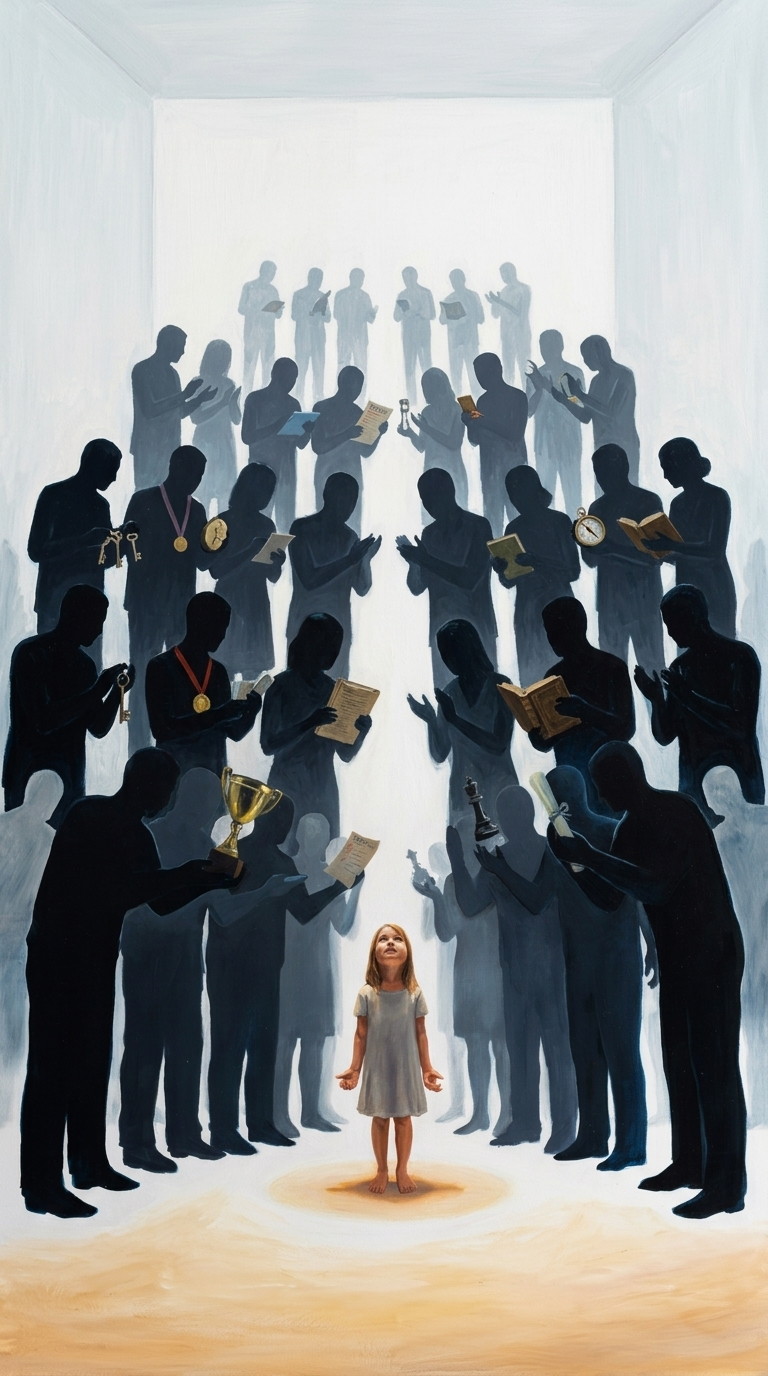
It’s not a book about robots. It is a book about parents and the way we fail them.

I must admit, when I first read Klara and the Sun by Kazuo Ishiguro, my first reaction was….meh. It didn’t blow me away. My biggest problem with the book was that you could take Klara out of the story and nothing would be different. Josie would have gone through the Lifting procedure, gotten sick, and recovered with or without her. The plot felt empty and thin.
So why is there such a buzz around this book, especially now that the first trailer for the film has launched? Is this story a case of the emperor’s new clothes?
After I finish any book, I take time to sit alone in my favorite chair in my quiet room and think about about the point of the book. What is the author trying to tell us and why is that important?
And it was during this quiet thinking when the point hit me like a pan galactic gargle blaster to the side of the head. The story and plot points in Klara and the Sun aren’t very important. What is important are the observations Klara the robot makes about us, humans…adults…parents.
As parent’s we can really screw up our kids and not even be aware of it.
As I think about the book, I am reminded of Catcher in the Rye. In Catcher, every adult has lost their sense of empathy and human connection. The adults express that loss through sarcasm, cynicism and, anger, usually directed towards Holden Caufield.
But in Klara, Ishiguro’s approach is subtle. When the adults are non-empathetic, manipulative, selfish and sometimes even cruel to Klara, she doesn’t respond or push back. She can’t. She’s a robot. She takes it. But we feel the emotion, the anger, the frustration for her. Ishiguro is forcing us to feel human for Klara. And most of the non-empathy, manipulation, selfishness and cruelty is done by the parents in belief they are doing these things in order to give their child the advantage over others in life.
And that makes me ask:
As parents, can we go to far in pushing for success in our kids?
What’s the toll we place on them?
Ishiguro’s warning to us isn’t about dystopian science filled with robots and A.I.. It’s a warning about the bargains we make in the name of giving our children an edge, and the emotional, social and psychological damage those bargains cost.
The first example is that the parents made a choice to have their youngest daughter, Josie, undergo a procedure called LIFTING. Lifting alters a child’s genetic makeup resulting in advanced intelligence. In the society of the book, this Lifting procedure is nearly required of all students who wish to attend university or advance schooling.
But the problem with the LIFTING procedure is two fold. First, the procedure is dangerous. Any child that is LIFTED runs a very serious risk of becoming gravely ill, or in some cases, die. The parents are aware of these risks. Their first born daughter, Sal, is killed by the procedure. Yet the parents still chose to have Josie LIFTED. They put their child in danger with the hope she will advance further in society.
Let’s be real, do we put our child in physical danger in order to advance them in society? No. Do we inflict stress, mental anguish, and self doubt wrapped in a blanket of pressure to succeed on higher test cores, placement in top schools, starting positions on the varsity teams, higher SAT and ACT scores? Absolutely we do. We do it because we tell them we love them. It’s for their own good. They’ll thank us later. But, the danger and damage we inflict isn’t as evident physically. It’s quieter, more mental and more emotional.
Second, the daughter, Josie, had no choice in the matter.
Josie never had a say in being lifted. She had no say in her own destiny. Her path was charted for her. The procedure was done to her when she was a very small child. And the consequences hers alone to live out.
This is the most dangerous warning Ishiguro is sending us. Josie was forced to live out the consequences, physically, socially and psychologically.
When we emphasize success (grades, school, job, etc.) we lose human connection.

In the book, all of the kids who went through the LIFTING procedure only socialize with other kids who also went through the procedure. As a result, their society has become separated, segregated into LIFTED and NON-LIFTED. In other words, the haves and the have nots.
The split society of the novel, Lifted and non-Lifted, only sharpens the point. The social engineering starts early: parents schedule interactions, curate friendships, and build lives around networking rather than connection. Kids like Josie attend private tutoring through a screen. Spontaneous play and hallway friendships are replaced by managed, adult-driven “gatherings.” When a Non-Lifted boy, Rick, enters this curated world, the other children can’t quite figure out how to connect with him, as if the very ability for unscripted human interaction has been bred out of them.
The trap Ishiguro is showing us is that the mother loves Josie. But her love has been overcome with anxiety about Josie’s prospects that the two have become indistinguishable. She is willing to gamble her daughter’s life to keep her competitive.
Strip away the science fiction and this is a recognizable scenario. We recognize the pattern of pressure: the travel teams, the tutoring stacks, the eleventh extracurricular, the quiet terror that our kid will be the one left behind. We tell ourselves it’s for them. Ishiguro’s question is sharper than that. At what point does “for them” become a euphemism for our fear of watching them fall short?
And as Josie gets older the caste system doesn’t stay contained to childhood. It grows into the adult world. The society has split into Lifted enclaves and anti-Lift holdouts. Klara notices all of this. She reflects to us a world with all human connective tissue removed. There are no random friendships, no serendipity, spontaneous moments of joy. There are only relationships managed for maximum benefit. The result is a loneliness that feels familiar in our own screen-bound algorithm driven era.
By the end of the book, Josie is a grown woman with stunted social skills, no emotional attachments and no sense of empathy or thanks for what Klara has done for her. Once Klara has served her purpose, she is cast off to the supply cabinet and eventually the junk yard. Ishiguro is warning us that we are doing the exact same thing to each other.
The core warning of the book is what should make us as parents most uncomfortable, because it’s happening now. We sort early and we sort hard, gifted tracks, travel sports, the “right” preschool, the zip code chosen for the school district. We build, with good intentions, the very segregation we say we’re against. Ishiguro doesn’t ask us to imagine a future caste system. He asks us to notice we’re already there.
We already know what it’s like to watch a kid’s social world shrink to the size of a screen, to schedule a “playdate” the way you’d schedule a dentist appointment. He asks us to wonder when our kids last spent an hour with another human being with no agenda attached.
Every one of these adults is acting from something close to love, or duty, or grief, or fear, and every one of them does damage. That’s not a coincidence Ishiguro lets slide by. It’s the thesis. Parents, and the adults standing in for parents, don’t usually fail their kids through cruelty. They fail them through anxiety dressed as care, through decisions made about a child instead of with one, through agendas, survival, status, guilt, fear of the world, quietly substituted for the child’s own choice.
Ishiguro isn’t writing a cautionary tale about gene editing or AI companions. He’s asking a much harder question, and he’s asking it of us specifically: when our fear for our kids’ future starts making decisions our kids never got to weigh in on, are we still acting out of love, or have we just found a more respectable word for control?
The next time you’re about to make a call “for” your kid’s future, the program, the procedure, the schedule, the sacrifice, stop and ask who the decision is actually protecting. If the honest answer is your own anxiety about how this kid reflects on you, put it down and ask your kid what they think instead. They’re paying more attention than we give them credit for. Ishiguro’s whole book is proof of that. Let’s not be the last one in the room to notice.


